Thursday, December 31, 2015

2015 in Review

I wanted to take a few minutes to summarize my year for a few reasons:
  • it was a pretty eventful year that I don’t want to forget
  • many people have asked me about it
  • most importantly, I’d love to reconnect with people I haven’t been in touch with, and meet like-minded people. So if something in here resonates with you, get in touch!
Here's the summary version:


We got off to a wonderful start with the birth of a baby boy in January. Needless to say, he has been a big part of our days and, more importantly, our nights since then. My wife’s family came to spend time with us after the baby was born, and my sister very sweetly came and spent three weeks of her vacation helping us survive.

I quit my job as a software engineer at google in May with only a fuzzy idea of what I was going to do next. But I’m getting ahead of myself.

We send my daughter to a co-op preschool, where parents are required to work one day a week with the kids in addition to a parents-only class about once a week. My wife had been doing that the past few years, but I took over as work parent for 6 months from January to June. It was an amazing experience to see her interacting with her friends and learning and growing over time. I also developed tremendous empathy for primary caregivers (mostly moms) and had my own tiny experience of parenting trauma.

Two recent obsessions of mine came together this year also. I’ve been following the Tiny House movement from afar - enamored by the idea of choosing to live simply. I’ve spoken to several friends who report a sense of freedom and lightness that comes with discarding possessions. Separately, ever since I was a kid, I wanted to go on an RV trip. About four years ago I almost bought a VW westy but decided against it for various reasons. Well in March we rented one for a weekend. It was meant to be a father-daughter trip but my wife was feeling up to it even though our son was just 8 weeks old. Before we got to the campsite, she told me that she was falling in love with it. So two days after getting back from the trip, I bought one. I love the VW more than other campers because of how small, yet how efficient and spacious it is. It isn’t much bigger than a regular minivan yet it has two double beds, a two-burner stove, a fridge, and plenty of storage. And of course, it is such an iconic vehicle.

We started hearing from so many friends and neighbors that they had amazing memories of taking trips in a VW west when they were young. One memory they all had in common was going to visit a mechanic on every trip they took. Being not at all good with stuff like that, I decided to sign up for an auto mechanic class at our local community college. It’s a class I’d been eyeing for a while, and it was the best $235 I’ve ever spent on my education. I’m definitely not capable of fixing a car after one quarter of classes, but I felt much more able to at least diagnose things to the first order, and ask marginally more intelligent questions of a mechanic. I ended up having to change a set of belts at the campground on one of our shorter test-camping trips so I’d call it a success.

While getting to know our van, I spent a lot of time going to various parks and vista's near our house and either meditating, or studying Digital Signal Processing and brushing up on Linear Algebra on Khan Academy (just one of those things).

My last official week working at google was spent traveling to London to teach a mindfulness class - Search Inside Yourself - to other googlers. Teaching mindfulness has been one of the most rewarding experiences of my life. It was total happenstance that I got to combine a personal passion/practice with a job. And to think that I’d get flown to Dublin, London and Tokyo the past few years to share that passion with my coworkers - what a rush!

Because of how much fun I’d had teaching mindfulness over the past few years, I wanted to explore the “crazy” idea of turning it into a career. Over the summer I got a chance to teach the same content at a few other companies. I was apprehensive for various reasons. At google I’d always been “just a coworker sharing my passion”. If I was now “the expert” coming in to teach this content, would I have to pretend to be something I wasn’t? Would it feel as authentic? I went it to each teaching arrangement with the same introduction being very honest about who I was and, more importantly, who I wasn’t. I was happy to see that what I had to say was well received, I was able to make a positive impact, and received outstanding reviews at the end of each course. I taught in Grand Rapids, MI, Duluth, MN, and Miami, FL - not places I’d ever imagined I’d be teaching mindfulness.

I also did a lot of writing. I did a lot of journaling over the months (I’d highly recommend investing in a fountain pen - I was amazed at how much fun it was to write with), and also started writing up thoughts on mindfulness at blog.meditationminutes.net. Of the many things I learnt, I have a stronger conviction that “how” I live my life is so much more important, and so much more difficult to change, than “what” I do. I hypothesized that, 40 years from now, I’d look back and wish for a life focussed on health, character, community, and service. I wasn’t successful making regular exercise a part of my life, though I tried hard during the beginning of the year. The taught me a bit about learning how to live.


July was spent “on the road” in our VW westy. We spent about 10 days driving up from Palo Alto to Seattle, a week in Seattle, and the rest driving east to Pullman, WA (where my wife grew up) and then back home via central Oregon. In general we’d planned it as 4 nights of camping followed by 2 nights in a hotel. What an amazing trip! I’d planned our packing list for months - refining it each time we did a practice camping trip. Eventually, I had every single piece of clothing and kitchen and pantry item written down and assigned to a particular spot in the camper. Having a place for each item was crucial to staying organized on a long trip. Kudos to my wife for agreeing to do this with a 4.5 yr old and a 6 month old, AND for doing it on our 10th anniversary. We got honked at a lot that week.


It was an exhausting trip. Both the kids behaved exceedingly well and yet, it was very tiring. But my did we see some amazing places. We fell in love with Oregon, and I realized how much I missed seeing snow capped mountains. We came back excited to be home, and enriched by the month. We’ve done more camping trips this year than we’ve done in the last eight years of living in the bay area. We’ve gotten rid of a lot of things at home in an effort to live more simply.

August and September were family months - my dad visited August, and we had a string of family visitors until the end of September.

My wife and I also hosted a small storytelling series  at our house - where a neighbor volunteered to tell indian folk stories to a bunch of kids in our neighborhood.

That’s when I finally started to feel an itch to start thinking about “work”. While I loved teaching mindfulness and I’ll continue to do more of it (i might be flying down under in April to teach there) I’m not 100% convinced that it’s the right time in my life to make that my career. I love the freedom that comes from it not being my primary source of income - I get to treat each engagement like an act of service, without worrying about the next teaching gig. As a side effect of my writing, a few friends and acquaintances have reached out to me, and I’ve been teaching mindfulness over What’sApp! - how crazy is that? I send a new guided meditation every time they tell me that they’ve done practicing the previous one for 5-7 days. No revenue model needed or wanted - just lots of love and a little bit of service.

After finally deciding to become a citizen earlier this year, I quickly got a chance to fulfill my civic duty as a juror. It was a fascinating experience. Listening to potential jurors being interviewed in a Palo Alto court was humbling. Everyone there was so accomplished; a dean from Stanford, an old woman who said she was retired and then just added as a side note that she had worked on life support systems for early NASA missions, successful entrepreneurs, physicists, the list went on. The case was a criminal case against someone who had been driving after a few drinks and had killed someone. So the selection process involved answering questions about personal experience with alcohol. It was also troubling to hear that there wasn’t a single person who wasn’t personally affected or didn’t have a friend or relative who was affected by alcohol. What a toll that drug takes on our society.

In August a ludicrous question had come to mind; “what would it take to provide banking services to a billion people?” It wasn’t really a question about technology or marketing or regulation, but a more fundamental observation about the business of banking. Banking relies on two business models - interest spread and transaction fees. Both of those are weighed against the lower income. To a bank, $100K in one account is better than $10K in 10 accounts. I am convinced that there exists a business model in which the customers are the asset/lever, not the assets under management. This spawned a few month exploration understanding the regulatory environment around banking, talking to the homeless, to retail bankers, private equity bankers, angels and venture capitalists, entrepreneurs, and anyone else who would listen - about the absolutely crazy idea of starting or buying a bank and then building a business based on radical transparency, generosity, and technology. There’s something there, but the lynchpin still eludes me so I’m putting the idea on ice for the moment.

A much less crazy idea spun out of this exploration, and it’s one I’m currently exploring. In our ever-more cashless society, it’s extremely difficult for kids to understand the value of money. Schools and some apps teach financial literacy through games or simulations, and some products exist to help kids get used to a cashless world (via a debit card), but there’s no product that guides kids and teaches them about money as they’re actually using it. A few of us are working towards a prototype that should result in kids leaving home with a solid credit history, experience using plastic, and responsible habits when given access to credit.

Phew. Would love to (re)connect with you so drop me a note.

And finally, Happy New Year! May you fill your 2016 with compassion, wisdom, and gratitude.

Wednesday, December 26, 2012

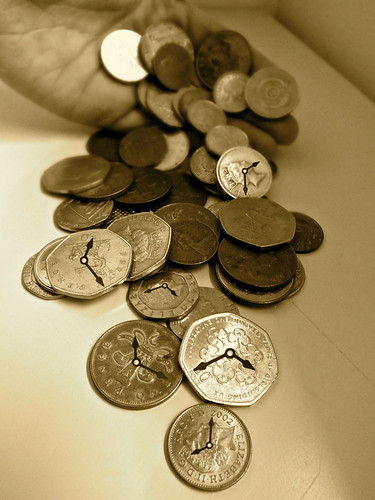
Money is Time

Money Is Time 
Living in the Bay Area where housing prices are insane, tradeoffs are very real. Pick any three - a good school district, a reasonable commute, adequate space, and a house less than a million dollars.


While thinking about these tradeoffs, it occurred to me that we are essentially traders in time. We:

  • put in our time 
  • to earn money 
  • to spend it on things 
  • that we didn't have time to spend making ourselves.


And then we make tradeoffs (where to live, how big of a house to have, etc) that help us allocate how we spend the money we earned, during the remainder of our time.  Often we put in more time at work so that we can have more money to buy more things.

But what is "buying" really? Money is only a store of value. Really we trade our time for other people's time - the time they spend learning how to do what they do, and the time they spend doing it.

Here's another way of looking at it. There is some lucky squirrel out there who absolutely loves what they do. When you slog away at a job you tolerate, to earn some money, so that you can afford some luxury that they provide (maybe they design clothes, maybe they cook food, maybe they build neat computer programs) - what you're really doing is subsidizing their hobby.

These thoughts were interrupted by my 20-month-old daughter insisting that I "play blocks".  And then it hit me. She is not part of this ridiculous self-referencing charade. She spends her time (almost) exactly the way she wants.

Somewhere along the way, we forget the big picture, and assume that we have to have certain things. And we give away 53% of our waking hours without even putting up a fight.

If you could start from scratch, reboot; what would you spend your time doing? 

Why not turn things around and spend your days doing what you love to do? I'm sure there will be enough fools out there willing to subsidize your hobby.

PS: In case you're wondering; I consider myself a pretty lucky squirrel. There was a several month stretch recently when I didn't. But then I decided that I was going to find people to subsidize my hobby.

Thursday, October 11, 2012

The Crazy Scifi Future is here.

Almost eight years ago, I got the chance to help bootstrap amazon's development center in Bangalore. One of the things I did was go on a recruiting trip to the Indian School of Business - one of the premier business schools in India.
As an 'out of the box' thinking question, I asked all the candidates: "Imagine that 3D printers become cheap enough to be available in your corner store. How should Amazon react to take advantage of the new reality".

I posed it as a thought experiment; a sci-fi question that seemed completely futuristic.

And here we are today in 2012. The MakerBot Replicator 2 costs just under $2,200. That's about the same price as the early laser printers.

I also just heard Chris Anderson talk about his new book - "Makers - The New Industrial Revolution" at google today and it blew my mind.

We're there. In that crazy sci-fi future.

Some quotes and links from his talk:

The guy who runs techshop is the same guy that used to run kinkos
 If you're a toy company, this should fill you with terror 
Hiring today is not about talent optimization, but about access optimization
and some random links that I want to refer back to later

Ronald Coase's Theory of the Firm
Autodesk123D
Thingaverse
Trimentional
Shapeways
Alibaba
Tinkercad
Lego Digital Designer

Wednesday, April 27, 2011

Sobering thoughts

It takes 10,000 hrs to be proficient at something.
Assume for a moment that meditation is the key to happiness.
How long until you achieve permanent bliss?

Life expectancy in the US =~ 80
Assume you start meditating at 30
You have 50 years of meditation available to you.

If you meditate:
- once a week for an hour => 192 yrs ~ 4 lifetimes.
- 15 minutes a day => 110 yrs ~ 3 lifetimes.
- 30 minutes a day => 55 yrs ~ 1 lifetime if you're lucky
- 1 hour a day => 23 yrs
- 2 hours a day => 14 yrs

So what are you waiting for? Time is of the essence.

Saturday, April 02, 2011

The Meditation Experiment


In January this year I decided to conduct an experiment.

I had just gotten back from my second 10 day meditation retreat, and - no surprises here - I met many people who'd done courses before, but had never followed up with the suggested two hours of meditation per day (two hours? who has two hours a day to spare?!). But the ones who had been meditating for a long time were convinced that a regular daily practice was the key to going deeper.

So I decided to commit to three months of meditating two hours a day. Why only three months? Well - let's just say that I've been told that, any time now, my life is about to turn upside down. I didn't want to make a commitment that I couldn't keep, so I decided to make a strong commitment for at least three months.

My wife wrote a short piece about meditation, and my commitment, on The New York Times' Well Blog. Since then, a lot of people have asked me if I've noticed any benefits, and what they are.

I have. I'm convinced that it's become easier for me to bridge the gap between the person I am and the person I strive to be. My friend who's an associate editor at Yoga Journal said that would make for a terrible quote in any reputable publication because it's such a general statement devoid of any specific examples.

But it's really hard to give specific examples because the benefits are so personal and subjective. And luckily this isn't a reputable publication. Would I behave differently if I weren't meditating two hours a day but only 15 minutes? What if I were chanting or praying instead of meditating? Who knows. I'm not really concerned about answering those questions because I'm not trying to test the efficacy of meditation (I'm convinced of it already).

My experiment wasn't about the meditation, though that was a crucial part of it.

During the course, one follows the eight precepts of Sila (Morality). Among these include 'non violence' - which also translates to being vegetarian, and 'no intoxicants'. The theory goes that perfect morality is an essential foundation for concentration, and concentration in turn is an essential foundation for Wisdom.

I've tried being vegetarian several times (longest stretch - one month), and also tried giving up alcohol (longest stretch - a year). I don't consume either in excessive quantities, and I've always enjoyed both - so I decided that I didn't really need to suppress my desire to consume them. Until now. I mean - would you forgo Wisdom for a plate of chicken tikka masala? (I know someone who just might)

Objective


Starting with the premise that meditation (especially at the two-hour-a-day-level, and after having spent ten, ten-hour days at a retreat) makes one more aware of oneself, I decided that I wanted to see if I could actually notice the effects of consuming meat or alcohol.

Experimental Method

Just giving them up wouldn't work - because I wouldn't have a good 'control' for my experiment. Instead I decided to limit my intake of both to: three times a week each of meat/alcohol in January, twice a week in February, and once a week in March. I marked every intake on google calendar with an A for alcohol and M for meat. I also annotated my calendar any time I had a particularly difficult sit.

A quick diversion. I realize that it is counterproductive to think of a Sit as either "good" or "bad". The whole point is to observe the reality of your experience as it is, in a non-judgmental way, and do so with equanimity. But that doesn't take away from the fact that sometimes I'd sit down and spend the hour calmly focussing on different parts of my body and other times my mind would be a storm, I'd struggle to keep my eyes closed, and then realize that it had only been thirty minutes. I marked those times with a "-1".

Observations

What I found was fascinating.

As suspected, it was almost impossible to have even one drink, and then sit down to meditate. I'd usually organize the evening so that I'd meditate first, and then have a drink (This was made particularly easy thanks to my awesome employer google, where there are meditation rooms on campus. I've meditated in several buildings in Mountain View, as well as in Seattle while on a business trip).

Also, as suspected, the morning after having a couple of beers was a little difficult. But I was surprised that even a single drink tended to have an effect on my meditation the next day.

But the big surprise was the meat. Sure - a big meal of red meat makes most people feel a bit sluggish, but I noticed that the effects of meat were just as unsettling on the mind as alcohol. Definitely less intense (I rarely planned my meditation around a meal unless it was going to involve alcohol), but tended to last for three to four sits (1.5 - 2 days). Dropping down from three meals a week to two, and then to one, really brought this point home. In March I was able to clearly see that the single meat meal upset a balance, whereas in January it was a little harder to notice since the various effects merged together.

On a side note - counting my meat meals had this strange effect where I'd always have to figure out if it was worth using my single meat-coupon (as I called in in my head) on any given meal. Suddenly sausage at breakfast, or chicken soup at lunch was just not worth blowing a coupon on. Note also that, given how fantastic the food at google is, the bar was extraordinarily high.

Conclusion

So where does that leave things now that it's April?

Now that I've meditated at least two hours a day for a little over one hundred days in a row, I really hope to keep going. In fact the thought of stopping pains me. I'm particularly inspired by someone about my age who's been meditating for over seven years.

What about the consumption restrictions? Contrary to my intuition, going through a period of "self-deprivation" actually ended up being instructive and wasn't just an exercise in masochism. If I hadn't controlled my intake in a systematic way, I wouldn't have been able to notice the effects.

But living in such a forced, controlled way doesn't necessarily add to a joyous life. I stand by my earlier conviction that if I give up something (meat or alcohol), it shouldn't be because of some sense that it is right but, rather, because it's just not worth it. Like how putting your hand directly inside a flame is just not appealing because you know you're going to get burnt.

So - I'm no longer counting my meals or my drinks. But I'm pretty sure, if I keep up my "daily practice", I'll change the way I eat and drink.

PS: That's not me in the picture. I don't meditate upside down, and I can't even do lotus position right-side-up.

Tuesday, March 01, 2011

Monetization Part III: Virtual Currency as Business Model Abstraction

This is the third part of my mini series on virtual currency monetization after Part I: Understanding Monetization and Part II: Social Games and Virtual Currency.

Dot Coms


Dot Com Sign

In the past decade, many companies assumed that publishing ("let's get a bunch of users and make a ton of money off ads!") was the only viable business model online since only a few companies (amazon, ebay) seemed to be able to actually sell stuff to people. But while some were making a killing on ads, most found it unsustainable - either their audience wasn't large enough, or it was too fragmented to sell to publishers.

Fast forward to a few years ago, and a few interesting things happened to challenge that assumption:
  • iTunes is wildly successful at distributing paid digital content
  • Facebook opens its platform, and some game developers figure out how to make more than half a billion dollars of revenue
  • the Fremium business model is successfully adopted by several services
...thereby showing that
  • some (many?) people are willing to pay for things online
  • it is possible to create a sustainable online business from paying customers
Today, entrepreneurs like my friend Max need to decide up-front whether to create a paid experience or to go with an advertiser supported model. This affects the fundamental design of their service, and may be a difficult decision to change down the road.

Social game developers, meanwhile, have hit on a formula that lets them abstract their monetization strategy from the experience they provide. Let me explain.

Abstraction

Remember (from my earlier post on Social Games and Virtual Currency) that developers price their experience in virtual currency, and provide multiple ways for users to earn that currency including playing the game, completing an offer, purchasing the currency, or paying for some sort of subscription.

That should sound super familiar to you from Part I which talks about the monetization funnel. Here's that funnel again (click to enlarge):

You can see that all of those methods of monetization live on the funnel too. And, just as you'd expect, the further down that funnel you go, the more virtual currency you get - because that's where the developer makes the most money.

For example, when you're just playing the game to get more points, the developer isn't really making much money off you. At most they may display some ads on the side that you happen to click - this was more popular a few years ago in the early days of social games. And so, earning currency by playing the game usually takes a long time.

On the other end of the spectrum, subscriptions is the most lucrative type of monetization because many people have too much inertia to cancel a subscription so even if they don't use your service, they continue paying you. That's why developers will offer you all sorts of extra benefits if you sign up for a subscription service.

What's so cool about this? Aren't game developers just re-using all the same tools that we've known about for decades?

What's cool is that they've created an experience that's agnostic of the particular monetization strategy. Whereas Max needs to decide upfront which strategy to pursue, using virtual currency adds a layer of abstraction that allows users to self-select, based on how they value their time and money. Developers create up a pricing model for their experience, and then provide different ways for users to obtain the virtual currency - setting things up so that value to them is about the same no matter how the currency is obtained.

So what next? Should Max use virtual currency for his online service? I'll share some final thoughts in Part IV:Virtual Currency for Everyone?

Monday, February 14, 2011

Monetization Part II: Social Games and Virtual Currency

In Part I of the Monetization Story, I wrote about an insight that my friend Krishna had shared with me pertaining to monetization, and also about my other friend Max's monetization dilemma when it came to designing his service.

The world of social games and how they use virtual currency is really quite fascinating, and I think could prove instructive for Max. But first, let's take a quick look at how that world works.

Farmville flowers

The experience (a tractor to tend to your farm) is priced in a virtual currency (2000 Farm Cash for the tractor). Why buy a tractor? It helps tend your farm, which lets you grow more stuff, which lets you build a bigger farm than your friends (Read more about game dynamics from Gabe Zichermann).

And how does one come by 2000 Farm Cash with which to buy the aforementioned tractor? Well, you could:
  • Play the game: Social games are almost always free to play. The more you play, the more Farm Cash you earn (but only a little), and the more involved you get. Maybe you invite your friends to play too. And just maybe now and then you accidentally click on an ad.
  • Complete an 'offer': Want to get 250 Farm Cash quick instead of slogging at the game for two days? How about signing up for a free Netflix subscription? Netflix has estimated the average value of a trial subscription at $70 (I'm making up these numbers somewhat). So they pay an advertising network $70, who pays another network $50, who pays another network $40, who pays the game developer $25 for every new netflix signup. The developer pockets $25 and gives you 250 Farm Cash. You're happy, the developer is happy, all the ad networks are happy, and netflix is happy too.
  • Whip out your wallet: Already signed up for all the free subscriptions and answered all the surveys you can bear? Still need some more Farm Cash to get ahead of your buddy? Pull out your credit card, and you can load up with 250 Farm Cash in seconds - for a mere $20.
  • Subscribe: Are you a baller? Subscribe to Club Pharm and, for $15 a month, you can get 500 Farm Cash as well as special member-only farm itemz!
Most people undervalue their time (they're the ones willing to spend hours looking for a deal that saves them $5) and they'll tend to play for free or by completing an offer. But every now and then you'll get a few loyal users who value your service, or their time, enough to pay you in cash.

Although only a few people will pay, it's estimated that over 80 percent of game revenues come from direct payments.

Reflecting on this, it's important to note that using a virtual currency doesn't magically mint money for you - it's just a useful representation of value, and is only as valuable as the experience it enables.

Using virtual currency instead of real money is useful for multiple reasons:
  • It provides an easy way for developers to incentivize specific actions within the game without actually giving away real money.
  • It makes it easy to price items and charge users small amounts of money
  • It retains the fiction of the game - it's less jarring to think about farm cash, rather than realize that you're spending hard-earned USD.
There are many tricks to making a virtual currency work well - like making it difficult for people to judge the 'real value' of that currency, making sure that the tasks that enable you to earn it are meaningful, and ensuring that there are sufficiently interesting things for people to spend their virtual currency on, so that they are enticed into figuring out how to obtain it.

However, what I'm really interested in doing is taking a step back and exploring if and how we can apply some of what games have done with virtual currency to the broader question of online monetization; hopefully in a way that will help Max. In my next post, I'll try to explain how I think games have been able to abstract away their monetization strategy, and then see if this is of general use to others.

Tuesday, February 01, 2011

Monetization Part I: Understanding Monetization

A few days ago I had breakfast with my friend Max to talk about growing and monetizing his online service. He asked about whether to monetize using advertising or subscriptions, and I drew something resembling the following:


He saved me from committing a start-up cliché by handing me an index card before I could use my napkin.

The Monetization Funnel


The idea for this came from my friend Krishna Motukuri. When I was still working fulltime on reporterist.com, I would periodically go on long bike rides with him, and listen to his valuable start-up advice afterwards over beers and burgers.
Krishna's insight was that in our economy everyone is funneling users towards a purchase/ consumption/ transaction point.
The farther you are from getting a user to that transaction, the larger your potential audience is but since, the value you are adding is tiny, you can only earn a small cut. On the other hand, the closer someone is to making a transaction, the higher your margins for getting them closer. But there’re only a few people who are that close.
So there’s actually continuum of monetization (using Crossfit as an example):
  • brand advertising – A billboard for a Crossfit gym.
  • various intent-driven advertising priced as CPC or CPA – An ad for Crossfit showing up when you search for “fitness” or on a body building blog.
  • lead generation – A gift (first month of membership free?) in exchange for getting someone to come into the gym and take a tour.
  • commerce – Signing someone up for their first crossfit class.
  • subscriptions – Subscriptions are obvious for gyms– but think about something like amazon subscriptions or prime)

Understand your funnel

Saying “I’m going to get lots of users and then figure out how to monetize” is okay (if you have the runway) but it’s still important to have a feel for the numbers. Some questions to ask:
  • How large of an audience are we talking about? A thousand users? A million? A hundred million?
  • Who wants to reach that audience?
  • How much is it worth to them?
  • How will you connect with them (the advertisers, not the audience)?
Max needs to figure out which funnel his service fits into, and what its shape is. If he can compare the approximate areas (revenue per user * audience size) at different points along that funnel he can figure out how best to monetize his users.
Not that getting these numbers right is easy – how do you know what a user is worth? How do you predict the growth or virality of your service? If you build an ad-supported experience, what do you do if you got your numbers wrong?

This is something I've been thinking about recently in the context of virtual currency. I think there's a connection. In my next post, I'll talk a bit more about games and virtual currency, and then try to explain why I think they've hit on something more generally applicable.

Friday, January 07, 2011

2010

Somewhat chronological highlights from 2010:
  • Started a company (restaurant waitlists via SMS; decided to sunset it eventually)
  • Reunited with the wife (we were coast-to-coast commuting)
  • Singapore/Malaysia vacation (met old friends, ate good food)
  • Big bicycle accident
  • Started working for google
  • Moved into a house
  • 2nd 10-day meditation retreat.

Looking forward to all that 2011 has to offer, since this too shall pass.

Sunday, July 18, 2010

Sunday in Singapore (Day 2)

Woke up at 6am and went for a run in Botanical Gardens with Sindya.
This time we found "Mr Prata" and ate a paper dosa, two pratas, fresh orange juice, and coffee. Mmm.

Came back and took a quick swim in the pool. After a short post-exercise-nap, we headed out to Serangoon Road and walked around taking pictures of Indians, making sure to keep an eye out for any Chindians (we may have seen a few, but not sure?). We ate at Ananda Bhavan, did an obligatory tour of Mustafa's, and then took a taxi to Grange Road.

Ah. Grange Road. Stopped at both Lucky Tower and Beverly Hill to show Sindya where I grew up. We even walked around on One Tree Hill Road - where my best friend used to live.

Checking out of the hotel to go spend the evening with the Iyer's. Tomorrow we catch a bus to Kuala Lumpur.

Impressions:
  • Singapore still has too many malls - it's freaking me out.
  • The food options are great. I'm full (but exercising just enough to keep my appetite)

Saturday, July 17, 2010

Saturday in Singapore

We got in to Singapore on Friday afternoon, surprisingly un-jetlagged.

The room is quite fantastic (will post pictures later) - good thing we aren't paying for it.

On Friday night we met up with Aditya and his wife in Clarke Quay, and had a beer at the Crazy Elephant. Then headed to a tiny hawker-restaurant-type-place near his house and ate chilli-crab, some chicken dish, etc. I know I'm allergic to crab, but had to eat it it anyway. Don't ask why I was under the impression that I wouldn't be allergic to Singaporean crab. So yeah - I had a mild allergic reaction on the way to bed.

This morning I got up and went for a run around the Botanical Gardens, in the pouring rain. Part of the mission was to search for Mr. Prata - a 24 hour Roti Prata place. The other part of the mission was to get rid of the pounding headache, and digest enough so that I could eat more. It was cool - I saw the little pond where I used to feed the swans with my mom growing up.

We worked out at the gym, showered, and then headed out in search of food. After some hunger-induced-panic, we finally found a food court (basement of Lucky Plaza) and ate Kaya Toast and Mee Siam.

We took the MRT to Harbour Front, and met up with Reuben - a.k.a. Jambool Intern version 1.0. He took us to The Cheese Prata Shop - near NUS - to eat Roti Prata (mmm).

Came back, did a complimentary wine tasting at the hotel, and then took a nap, tired from all the walking. Went out for a late-night snack at a Chinese vegetarian restaurant on Orchard Road.

Impressions:
  • there are way too many malls in Singapore
  • so many road names are giving me flash-backs to my childhood. Even some of the geography is coming back to me (within the 1-mile-radius that I knew as a child)
  • it's pretty dang humid here
  • for a place with not much to actually see, they've done a great job marketing it as a tourist destination
  • there are way too many malls in Singapore
Tomorrow I will take S to the street where I grew up.

Thursday, July 15, 2010

trip update

The Wife and I are headed to Singapore and Malaysia. Here's what we have planned:

- a weekend in Singapore - showing her where I grew up, meeting some old friends, and eating
- a couple of days in KL - staying with my alternate-mom (a.k.a. Aunty Ann), checking out KL, eating.
- 3 nights in Pulau Redang - tropical beach paradise.
- a few days free (current thinking is to go into the teman negara rainforest)
- a night in Singapore
- back home

We are unwittingly taking the scenic route to Singapore. San Francisco - Hong Kong - Bangkok - Singapore.

On the bright side - hopefully that will result in more meals (and miles?)

Not sure how regularly we'll (want to) have internet access...

Sunday, December 13, 2009

Doing what you love

The wife recently linked to an essay by Paul Graham titled How to Do What You Love.

He's an awesome writer and reading his writing is almost always inspiring, and definitely always thought provoking. Here are some of my favorite quotes from it:


Unproductive pleasures pall eventually. After a while you get tired of lying on the beach. If you want to stay happy, you have to do something.


All parents tend to be more conservative for their kids than they would for themselves, simply because, as parents, they share risks more than rewards. If your eight year old son decides to climb a tall tree, or your teenage daughter decides to date the local bad boy, you won't get a share in the excitement, but if your son falls, or your daughter gets pregnant, you'll have to deal with the consequences.


"Always produce" is also a heuristic for finding the work you love. If you subject yourself to that constraint, it will automatically push you away from things you think you're supposed to work on, toward things you actually like. "Always produce" will discover your life's work the way water, with the aid of gravity, finds the hole in your roof.


and finally:


Finding work you love is very difficult.


BUT - he misses an important point. I don't think that Finding Work You Love should be a life goal in and of itself. How absurd to constrain your happiness in such a limited way!

The only point of Finding Work That You Love is to experience it and, from it, learn how to love doing everything - from the most mundane to the "extraordinary".

I'm pretty sure I love programming. But I have a strong hunch that it's not the programming I love, but just that it happens to make it easy for me to express creativity, make something beautiful, and work towards perfection.

Now if only I could transfer that sense of craftsmanship into doing my taxes...

Wednesday, July 29, 2009

Simulating the act of Movie Watching

So as you know, we've been experimenting with a slightly different form of expression.

With the latest post - "away we go" - we were trying to convey the fact that we had a conversation about a movie. Yeah I could link to the movie, but how cool would it me to make it look like we were actually watching the movie!?

I had some vague images in the back of my mind of the effect I was thinking of which, someone later pointed out, came from Mystery Science Theatre 3000. The idea being to let people watch the movie (or movie trailer in this case), but still retain the feel of the rest of the blog.

Basic Idea


So it's done using 3 pieces:

  1. A background image on a div:

  2. A youtube embed with a fixed size

  3. A transparent png:


    (i added in a red background to make the transparency obvious)


Process


  • I started, as always, by painting the image on a business card and scanning it in.

  • I used a free drawing program - Pixen - to draw a black rectangle of the exact dimensions of the youtube embed (480x295 in my case), and then resized the drawing slightly so that it framed the rectangle. This got me to
  • I then copied the bottom half of the image, and erased all of the stuff around the seats and heads so that it was transparent

  • I played around with some html in an editor, and came up with something that looked like:

    div style="background-image:url( '...' ); padding:;" // the background
    object embed // the 'movie'
    div style="z-index:999;position:relative;..." // the silhouettes
    /div

  • Finally, wordpress.com doesn't like object-embed tags, so you have to use [youtube=url] link instead


and that's it. obviously it doesn't quite look like an MST3K episode, and there's definitely some improvements that could be made (the head shapes got a little messed up when trying to make the transparent png).

But overall, I'm pretty happy with the end result.

As my buddy mentioned, you could take this a few steps further and do all sorts of effects using simple HTML and a bit of javascript.

Thursday, July 09, 2009

A comic take on life

I got a little sick of writing on this thing, so I'm trying a new technique. Check out This Comic Life.

Saturday, February 28, 2009

work, geeking out, meditation, fun, housing, blogging

on Work


I've been really busy the past month, working hard to bring credit card payments to social games. And we just did a limited launch last week. It's been an amazing experience.

Payments sounds kind of dry at first, but it's a great mix of business-logic and performance.Enough business-logic-complexity to make it a challenge to design clean code; but not enough to make me rip my hair out. Enough performance considerations that I get to work on fun little performance improvements, but not enough that I lose sight of the larger business goal. And I'm learning a whole new domain and lingo.

on Geeking Out


I've been working on a few small projects on the side. The first is a really simple-but-surprisingly-addictive application that I call The Decider. Go check it out, and let me know what you think.

The second is a little piece of open-source goodness to help rails websites load faster for the customer. Edge-caching has traditionally been the purview of larger organizations with multi-media-intensive content. It just didn't make sense for the "little guy" to even think about it. But then Amazon released Cloudfront - a pay-as-you-use edge caching webservice and, once again, changed the game. I don't know how many people realize what a game changer this is. I suppose most people look at Cloudfront and think "Ah - when my site gets big enough I'll think about edge caching". That's what I thought when I heard about the release.

But then I got thinking - the apps I work on at Jambool (where I work now) aren't media rich, but it's important for our widgets to load blindingly fast for our customers. And, as I was looking into tweaking our load-times, I realized that edge caching simple things like javascript and css would make things even faster. Anyways, the xlr8 ('accelerate', for the slow) is the product about 6-8 hours of work. It works, but is still an early incarnation.

on Meditation


I went to the dentist a few weeks ago and she tried to sell me about $1,000 worth of dentistry. I'm trying to see if I can put some of the work off until my next India trip (where the total cost will be less than my co-pay here). But she also tried to get me to buy a mouth-guard to prevent me clenching my jaw. I don't grind my teeth at night, but I do clench my jaw, mainly because I've been pretty stressed out for the past year. I decided that, rather than shell out the $250 to mitigate the symptom, I'm going to try to address the cause.

Two years ago I attended a 10 day Vipassana retreat. It was among the most difficult, but most rewarding experiences of my life. And left me with one more tool in my toolbox-for-life. They recommended 2 hours of meditation per day, which I faithfully followed - for about 3 days. So for the past month or so, I've been trying to revive my practice but manage to sit for no more than 20 minutes at a time.

And then a friend of mine suggested that we go to a weekly sit in Berkeley. He got sick and had to bail, but I ended up going last Thursday. It was fantastic, I was able to sit for 45 minutes with relative ease, and felt the afterglow for the next 24 hours. I won't go as far as to say that I'm going to go every week, but I do hope to be a bit more regular.

on Fun


Two weekends ago, about 21 people (mostly Indian friends of mine from college, along with other friends, significant others, etc) got together in Taos, NM for our annual ski trip. It was, as usual, lots of fun. We normally do a Friday- Monday trip but a few of us flew in on Wednesday night so we had more time to acclimatize to the altitude, to relax and chat (and geek out) with friends and, of course, ski.

The wife and I stayed at the Ojo Caliente Hot Springs on Monday night as well - and that finished off the trip just right.

This morning I went surfing in Pacifica. It was still a little cold and the waves weren't that great.

Next week, the wife and I are heading up to Mount Baker, WA for a company ski trip.

I love the West coast.

on Housing


We've been idly thinking about the possibility of buying a place to live, instead of continuing to pour money down the rent-drain. Any suggestions on neighborhoods that I might like in the SF Bay Area? I'd love to stay in SF, but it's out of our budget. I think I'd want something that's

  • 5-10 minute walk to a major bus/train route to downtown

  • < 45 minute public transport commute to downtown

  • 10-15 minute walk to a light-commercial area (coffeeshops, bars, restaurants, neighborhood grocery store)

I don't think we're going to find anything affordable in the Bay Area, and I'm not sure which one of the above I'll have to compromise on. We might have to look up in Seattle instead? Who knows.

on Blogging


My blogging dropped off initially because I lost my main audience and subject-matter (when we moved back to India, I was trying to keep in touch with friends in Seattle. When we moved back, I didn't have the need to blog as much). Then I started doing a lot of information-sharing using Faves. And then I started trying out twitter and facebook status updates as a way to 'micro-blog' my thoughts.

But, like the Kindle vs news-on-the-iphone, or reading an rss-feed - I feel like there's a place for a slightly longer form of reading/writing, which blogs seem to be be good for.

That said, we'll see if I can be a little better about writing medium-sized semi-regular blog entries.

Tuesday, November 18, 2008

raw food

Yesterday morning, I went to breakfast at Cafe Gratitude. We'd seen Gratitude before in Berkeley, but the wife's rationale was always "if I'm going to pay to eat out, I want hot, cooked food". After climbing at the gym though, we figured we'd drop in for a quick snack and give it a try.

Here's their menu. We had two juices ("I am Rejuvenated", and "I am Charismatic") and shared an enchilada ("I am Elated"). The juices were fantastic. And the enchilada was much tastier than I had imagined. The best part was that both of us left there feeling like we were bouncing off the walls - just really energetic. We'd just worked out, and had some great food.

It didn't hit me until lunch time - when I was at work and got a sandwich from Quizno's. The difference in how I felt after the two meals couldn't have been more stark. Whereas I really felt enlivened after breakfast, the lunch food made me feel dull, tired, and sleepy.

I've read a little about Raw Foodism in passing, but haven't really dug deeper. Anyone have experiences they want to share?

The wife and I decided that we're going to try eating at Gratitude again in the next few weeks. If we feel the same way, I'm going to try to learn more about that style of food and see if we can add some more raw foods to our diet.

Friday, November 07, 2008

Credit

I've been sitting on this post for a long time - mainly because I'm not a finance-world native (or inhabitant). But too little has been said about the importance of credit rating agencies.

A few months ago, a very left-leaning journalist friend of mine asked me to listen to a This American Life show entitled The Giant Pool of Money. It's a great show that tries to get at some of the characters in this drama - from a borrower, to a lender and reseller, and so on up the chain. As always - they portrayed some great characters.

But whereas Ben listened to that show and felt nothing but contempt for the bankers who made their millions (and were now worried about living their lifestyle on less that $20K per month), I came away with a slightly different take. Yes - that banker was a douche with his I-chill-with-B-list-celebrities lifestyle, but really, everyone in the chain was just making the best of their situation.

That chain of people existed all over the world. The borrower was smart for recognizing that he/she could get a massive loan with no money down - a risk-free proposition that was too good to be true. The lender realized that he could make great commissions, and sell even the sketchiest of loans. The people 'securitizing' large portfolios of loans also knew that they could get away with what they were doing, and kept purchasing below-par loans, and getting them rated highly. And the credit-rating agencies were getting paid lots of money to give these portfolios good ratings, so they kept at it.

So what am I saying? Is no one to 'blame'?

What annoys me that people still make references to the credit worthiness of certain companies, bonds, or whatever - based on those same credit ratings. Remember - those credit ratings that were given under such a conflict of interest.

The credit-rating agencies were the ones that provided lubricant for the entire rest of the chain. If it weren't for their excellent ratings, investors worldwide would never have put their pension funds in securities which consisted of underperforming loans bought from a knowing and incredulous lender who loaned a boatload of money to any warm body that wanted it.

There are many reasons why I'm unhappy about the bailout. But relevant to the discussion above is the fact that investors who wrongly trusted the credit ratings never got burnt. And so they, and we the public, continue to put our trust in them. As if Moody's improving or dropping the rating of a particular bond should hold any water. The bailout short-circuited the natural feedback mechanism that would have resulted in investors deciding that credit-rating agencies needed more transparency if they were to be trusted, and that investors would need to do a significant amount of their own due diligence before making an investment (and not just relying on a 3 letter rating).

What else was bad about the bailout? No one really gave a thorough explanation of what would happen if there was no bailout. The so called experts just shook their heads, wagged their fingers and said that things would be "so bad, that it was beyond comprehension".

Really? Isn't it interesting that these 'experts' were the ones who stood to gain the most from a bailout (the community of bankers, not necessarily specific people)? And isn't it interesting that these great proponents of free markets suddenly decided that free markets would not be able to solve this situation?

I'm not arguing against a bailout. I honestly don't know enough to know that it wasn't required. But I do know for sure that the public was hoodwinked yet again. There was a crisis, a rhetoric of fear, a waving of hands, and presto - the enormous financial risk that should have been borne proportionally by the people who made investments was suddenly spread thinly across the American people.

And so, we continue to fight for low interest rates, which can only be sustained by the enormous amounts of cash that the American public has put up. We taxpayers are effectively lending money at well below the fair cost of capital. What do I mean by that?

If there was no bailout, it's not possible that money would not be available. Money would be available. It would just be available at ridiculously high interest rates. There are enough people in this country who are sitting on several hundreds of millions of dollars; who'd be willing to lend it out for 20 - 30 - 40% interest. And maybe that reflects the true risk of lending money in today's environment. So why are taxpayers shoring up the money to lend to banks at rates significantly lower than that? It doesn't make sense.

It's just unfortunate that the wool has been pulled over our eyes yet again. Once when this country rushed to fight a war in a country that had nothing to do with the terrorist threats that it was supposedly reacting to. And again this year, when we mortgaged our futures so that the financial world could try to maintain its status quo.

Tuesday, October 28, 2008

Smoother cloud deployment

Jambool is growing fast and we'll soon need a much smoother way to manage our deployments.

As preparation for some of our code and deployment cleanup, I wrote a little plugin - capistrano-sdb that allows you to store your capistrano configuration in Amazon's SimpleDB.

Capistrano is a deployment automation tool that greatly simplifies the task of deploying code (especially ruby on rails code) to a bunch of servers. SimpleDB is, well, a simple db in the cloud.

My plugin allows you to use simpledb in one of two modes - either as a fallback for capistrano's config system, or as an override to it. Why would you ever want to do that?

Dynamic configuration can sometimes get out of hand - because it's hard to debug. However, dynamic configuration for deployment-related variables is a great idea. In today's world of cheap, throw-away hardware, servers are constantly being replaced. We're also iterating constantly on new services in our services-oriented-architecture, and information on where those services run needs to be up-to-date.

Using simpledb for deployment configuration is one building block towards an autonomic server environment. Stay tuned for more.

Wednesday, September 17, 2008

facebook developers

(Read about the RockYou screw up)

And here's the list of email domains. Among other interesting insights, geeks prefer gmail over yahoo.


165 gmail.com
28 hotmail.com
27 yahoo.com
5 rockyou.com
3 stanford.edu
3 live.com
3 berkeley.edu
2 yahoo.co.uk
2 iwidgets.com
2 googlegroups.com
2 faceitapps.com
2 cpmadvisors.com
2 campusbin.com
2 buddymedia.com

I've snipped the rest - they are all company email addresses.