As of this morning, Sindya and I are signed up to row for an hour every morning on Ulsoor lake, from 6:45 - 7:45. It's *amazing*. We're spending the first week rowing on a fixed boat (it's tied to the dock) to learn the technique.
The location (Trishna Yacht club) is Army property but they allow civilians to use it, through a company called Catapult Connect. The coaches are all super friendly Army guys who've competed nationally or internationally. Six days a week for 23 more days, we'll be waking up at six, taking a quick run around Ulsoor Lake, and then rowing for an hour.
Monday, August 08, 2005

Saturday, August 06, 2005
rails on fcgi
I've been working on prototyping a small rails app at work this week. On Friday I decided that I had enough functionality to be able to do a basic demo, so I decided to focus my attention on getting the demo up and hosted before getting back to fleshing out the functionality.
Since then I've been in config hell. Things were running really slow on my box because I was using CGI. Like an idiot I decided to switch to using lighttpd->fcgi->rails instead of apache->cgi->rails, but do it all in one go. I can't believe I still don't know better than to try doing multiple switches like that in one go.
Anyways, I came to my senses this morning and followed the following excellent instructions on getting fcgi set up on my local box. After (almost blindly) copy-pasting the commands, my app is up and running a lot faster with fcgi support.
The next step is to make the apache->lighttpd switch.
Since then I've been in config hell. Things were running really slow on my box because I was using CGI. Like an idiot I decided to switch to using lighttpd->fcgi->rails instead of apache->cgi->rails, but do it all in one go. I can't believe I still don't know better than to try doing multiple switches like that in one go.
Anyways, I came to my senses this morning and followed the following excellent instructions on getting fcgi set up on my local box. After (almost blindly) copy-pasting the commands, my app is up and running a lot faster with fcgi support.
The next step is to make the apache->lighttpd switch.
Wednesday, August 03, 2005
out of this world.
this is nuts. check out the moon.
And, for shitsandgiggles, make sure you zoom in all the way.
hat tip, google blog.
And, for shitsandgiggles, make sure you zoom in all the way.
hat tip, google blog.
no way!
a multibutton mouse from apple!
One wonders why exactly it took them over a decade to realize that it's useful to have more than one button. Though I agree that more buttons is not always better; I have almost never used the 'forward' and 'back' thumb-buttons on my Microsoft mouse.
One wonders why exactly it took them over a decade to realize that it's useful to have more than one button. Though I agree that more buttons is not always better; I have almost never used the 'forward' and 'back' thumb-buttons on my Microsoft mouse.
Monday, August 01, 2005
amazon 10 yr celebration
SO amazon.com had quite a big celebration for its 10 yr anniversary; a concert featuring Norah Jones and Bob Dylan.
We had a company picnic/10 yr celebration in India as well. We went to the Kings Sanctuary resort in Nagarhole. We left on Friday morning with two big buses and a small tempo, and arrived there in time for a late lunch. The rooms there were pretty amazing, and Sindya and I were lucky (with a little help from Rekha as well) to have a cottage to ourselves (most other people slept 4 to a cottage - two in the bedroom and two in the living room).
We went out for a safari that afternoon. We didn't see any tigers; we just missed seeing one by about 10 minutes. Ironically, people travelling on a loud, interstate bus saw a tiger whereas we (travelling in jeeps, specifically there to see the wildlife) didn't. We got to see lots of spotted deer, some Sambar deer, a wild elephant, a Gaur (I think it's the same as a bison), two types of monkey (langur, and one other) and a bunch of birds whose names I forget. We got pretty cold and wet, it rained the whole weekend. After the safari, we had dinner and drinks. A couple of us went for a midnight dip in the pool.
Vikas and I had brought some climbing gear so at 7:30am on Saturday twelve of us got into the tempo and went to a nearby rock for some clibming and rapelling. Vikas and I set up rapell with the help of the guide (he actually is an entertainer at the resort who'd just learnt to climb by watching people set stuff up there). Apart from the two of us and Pooja, no one else had rapelled before so they needed a lot of convincing to lower themselves off the edge of a cliff. Pooja required the most ;) We didn't have time to climb, but I think everyone had a great time. Shivam and Harman came away with a few bruises since they were the first two (after Vikas) to try rapelling down so didn't have a good idea of how it was done. Sorry guys!
We got back to the resort, played in the super-cold swimming pool for about 45 minutes, had lunch, and then got back on the bus to head back. It was a good break.
Now I have to plan a real honeymoon before the wife kicks my butt!
We had a company picnic/10 yr celebration in India as well. We went to the Kings Sanctuary resort in Nagarhole. We left on Friday morning with two big buses and a small tempo, and arrived there in time for a late lunch. The rooms there were pretty amazing, and Sindya and I were lucky (with a little help from Rekha as well) to have a cottage to ourselves (most other people slept 4 to a cottage - two in the bedroom and two in the living room).
We went out for a safari that afternoon. We didn't see any tigers; we just missed seeing one by about 10 minutes. Ironically, people travelling on a loud, interstate bus saw a tiger whereas we (travelling in jeeps, specifically there to see the wildlife) didn't. We got to see lots of spotted deer, some Sambar deer, a wild elephant, a Gaur (I think it's the same as a bison), two types of monkey (langur, and one other) and a bunch of birds whose names I forget. We got pretty cold and wet, it rained the whole weekend. After the safari, we had dinner and drinks. A couple of us went for a midnight dip in the pool.
Vikas and I had brought some climbing gear so at 7:30am on Saturday twelve of us got into the tempo and went to a nearby rock for some clibming and rapelling. Vikas and I set up rapell with the help of the guide (he actually is an entertainer at the resort who'd just learnt to climb by watching people set stuff up there). Apart from the two of us and Pooja, no one else had rapelled before so they needed a lot of convincing to lower themselves off the edge of a cliff. Pooja required the most ;) We didn't have time to climb, but I think everyone had a great time. Shivam and Harman came away with a few bruises since they were the first two (after Vikas) to try rapelling down so didn't have a good idea of how it was done. Sorry guys!
We got back to the resort, played in the super-cold swimming pool for about 45 minutes, had lunch, and then got back on the bus to head back. It was a good break.
Now I have to plan a real honeymoon before the wife kicks my butt!
Monday, July 25, 2005
catching up on reading
learning from mistakes:
I think I often fall into a rut where I get scared to take risks because of the above. It's good to read shite like that every now and then to jarr me out of my apathy.
- For anyone than never discovers a deeper self-identity, based not on lack of mistakes but on courage, compassionate intelligence, commitment and creativity, life is a scary place made safe only by never getting into trouble, never breaking rules and never taking the risks that their hearts tell them they need to take.
I think I often fall into a rut where I get scared to take risks because of the above. It's good to read shite like that every now and then to jarr me out of my apathy.
Thursday, July 21, 2005
The curious incident
There were two chapters I absolutely loved in this book:
On death (chapter 61)
and on life (chapter 199)
(you should be able to read those excerpts online thanks to amazon)
On death (chapter 61)
and on life (chapter 199)
(you should be able to read those excerpts online thanks to amazon)
Sunday, July 17, 2005
Random
Posting has been light because I've been
So here's some random stuff:
Oh and, just so it doesn't get lost in the jumble above, I have to mention separately: you MUST check out prince of ayodhya - a contemporary rewriting of the Indian epic Ramayana. It's the first in a 6-book series, four of which have already been published in India. I suffered the wrath of my wife for burying my head in these books the past few weeks. They're amazing. The story itself is so gripping, and Mr. Banker just makes it even more irresistable by retelling it in a vernacular that's familiar and easy to follow.
I'm at home house-sitting while the cook and maid do their thing. Sindya is out running a program for Dream-a-dream that she's planned, called Monsoon Madness. It's a day long talent-show/competition for underpriviledged kids. They'll be painting, dancing, acting, taking quizzes, and making collages. As soon as the maid gets done, I'll be back there shooting video and hanging out with the kids. Until then, I'm a domesticated husband (damn that sounds scary).
- sick
- trying to figure out the intricacies of married life :)
So here's some random stuff:
- Since I started working, I never really made a conscious effort to save; I just made sure I didn't splurge. The result was that I was able to put away about 40% of each month's take-home. I've been following the same strategy in India - making sure not to splurge, but definitely not being super-conscious of my spending. The result is that I'm not able to save much money at all. That bothers me.
- I have a fair amount of indian classical music on my ipod. I manage to go through my other music collection using the 5-star rating system, along with dynamic playlists. I hadn't found a good way of going through my classical collection though. Using information from this page I've managed to build up 4 playlists (morning, afternoon, evening, night) so I can listen to the 'appropriate' pieces. However, I'm now longing for even finer-grained control of my collection. I wish I had a SQL front-end to the iTunes db.
- One of my friends (Vikas) has an awesome cook, who's agreed to come cook at our place once a week. She makes awesome food. She's given me a list of stuff I need to buy though :) belan (rolling pin), some plastic containers, a bunch of specialized steel kitchenware (container for flour, plate for kneading dough, etc). To add to my already-over-equipped kitchen.
Oh and, just so it doesn't get lost in the jumble above, I have to mention separately: you MUST check out prince of ayodhya - a contemporary rewriting of the Indian epic Ramayana. It's the first in a 6-book series, four of which have already been published in India. I suffered the wrath of my wife for burying my head in these books the past few weeks. They're amazing. The story itself is so gripping, and Mr. Banker just makes it even more irresistable by retelling it in a vernacular that's familiar and easy to follow.
I'm at home house-sitting while the cook and maid do their thing. Sindya is out running a program for Dream-a-dream that she's planned, called Monsoon Madness. It's a day long talent-show/competition for underpriviledged kids. They'll be painting, dancing, acting, taking quizzes, and making collages. As soon as the maid gets done, I'll be back there shooting video and hanging out with the kids. Until then, I'm a domesticated husband (damn that sounds scary).
Sunday, July 03, 2005
back from my wedding
To check out pictures from my wedding, subscribe to this feed.
If you took pictures at my wedding and want them as part of this slideshow, upload them to flickr and tag them with 'sindyaandhemant' as well as 'wedding'.
More updates later.
Update: flickr's rss feed seems broken. the atom one works okay (link updated above), however it only shows the last 10 photos. Since I'm uploading a bunch of them, you'll miss out on some photos. You may just want to check out the slideshow instead.
If you took pictures at my wedding and want them as part of this slideshow, upload them to flickr and tag them with 'sindyaandhemant' as well as 'wedding'.
More updates later.
Update: flickr's rss feed seems broken. the atom one works okay (link updated above), however it only shows the last 10 photos. Since I'm uploading a bunch of them, you'll miss out on some photos. You may just want to check out the slideshow instead.
Sunday, June 12, 2005
lightpost
posting will be light for the next few weeks.
In a few hours I fly to Delhi.
Tomorrow morning I fly to Leh, Ladakh for a 5 day trek in the Indian Himalayas.
After that I head back to Delhi and on to Pune for about 10 days during which time I will relinquish my bachelorhood.
I may be online and checking mail from Pune but probably not posting. Will be back to the grind sometime in July.
In a few hours I fly to Delhi.
Tomorrow morning I fly to Leh, Ladakh for a 5 day trek in the Indian Himalayas.
After that I head back to Delhi and on to Pune for about 10 days during which time I will relinquish my bachelorhood.
I may be online and checking mail from Pune but probably not posting. Will be back to the grind sometime in July.
prediction
I wrote parts of amazon's remote-service-invokation framework a few years ago, after which a few of us worked on collecting detailed metrics from the framework so as to guage the health of the system and try to predict business-impacting problems before they actually, well, impacted business.
I'm currently reading blink by Malcolm Gladwell and it's a facinating book. No time for a full review right now. But here's a quote that caught my eye (he's talking about an algorithm for deciding the seve rity of heart-attack-like symptoms in ER patients, and has just listed several high-heart-attack-risk lifestyle factors):
(The book, by the way, attempts to explain intuition and how it is that we can get such strong (and often correct) intuitions without being able to understand exactly why. It also attempts to analyse the cases in which our intuition is terribly wrong. See also this entry by Trevor for more about intuition.)
This is cool because our hunch over the past few years has been that it will only take a few metrics to actually predict a given failure scenario, but deciding which ones to pick is the hard thing. So the kinds of systems we are trying to build end up being quite similar to what (I just found out) humans are doing. We're constantly taking hundreds or thousands of input variables (subtle changes in a persons face or 'body language', things seen in the periphery of our vision, etc.) and doing some realtime statistical analysis on them. Except our consciousness is never burdened with any of that. Our subconscious builds and refines these elaborate statistical models over time. Then, it can bubble up signals (in the form of intuition) to our conscious mind with very limited information because it has already made models about which variables are important enough to matter.
How does this apply to metrics and monitoring? It's infeasible and foolhardy to track the state of every possible instrumentable variable in your system in realtime and use that to drive failure detection and root cause analysis. But
If failure detection is like the pit in your stomach or lump in your throat, and root cause analysis is like the logical reasoning that we sometimes go through when making decisions, then maybe we have to accept that failure detection is a much faster process than root cause analysis. Our group has always looked at those as two different processes, but never acknowledged that they may require different amounts of information.
On one level, that looks hopeless; "what good is it to know that something is wrong if you don't know what it is?" But we do that all the time. A lot of us learn to trust our instincts (don't walk down that alley) even if we can't tell exactly what's wrong (it's well lit, there are people around, but it just feels shady).
How could that help in managing distributed systems? The only example I can think of right now is: if a host 'feels like it's unhealthy' it could just take itself out of a load balancer without knowing what was wrong.
It does tell me is that it may be worth completely separating the process of detection and root-cause analysis. So that the feedback in (3) above is not "the root cause of this disturbance was xyz", nor is the list of 'important' metrics in (2) a list for each possibel root cause. (i.e. you don't output something that says that metrics A and B are important for predicting a disk crash, but metrics D and F predict a web server failure and metrics C and E predict that your application is deadlocked). That's how antivirus software is modeled. It builds up fingerprints of different viruses and tries to match the fingerprint. It does both detection and root-cause-analysis in a single step. (OK, maybe modern antivirus software does more than that, but stick with me for a moment).
Instead, maybe the right but counterintuitive (no pun intended) thing to do here is to only store whether or not "Bad" things happened, and store the set of metrics which are good predictors of "Bad"ness. You'd probably need more than a binary notion of Badness. This doesn't get us closer to solving problems, but maybe it can help reduce downtime in the first place, because we've got a very good early-warning system.
It'll be interesting to see if any more insights come out of watching a large system running (the group I've been working with in Bangalore is getting closer to releasing an internal, scaled-down version of what will eventually be a large self-healing distributed system). Since I've been in development mode for the past few months (vs. supporting a live system), I feel a little unqualified to rant too much about this stuff. :)
I'm currently reading blink by Malcolm Gladwell and it's a facinating book. No time for a full review right now. But here's a quote that caught my eye (he's talking about an algorithm for deciding the seve rity of heart-attack-like symptoms in ER patients, and has just listed several high-heart-attack-risk lifestyle factors):
- ... It certainly seems like he ought to be admitted to the coronary care unit right away. But the algorithm says he shouldn't be.
<snip>
What Goldman's algorithm indicates, though, is that the role of those other factors is so small in determining what is happening to the man right now that an accurate diagnosis can be made without them. In fact <snip> that information is more than useless. It's harmful. It confuses the issues. What screws up doctors when they are trying to predict heart attacks is that they take too much information into account.
(The book, by the way, attempts to explain intuition and how it is that we can get such strong (and often correct) intuitions without being able to understand exactly why. It also attempts to analyse the cases in which our intuition is terribly wrong. See also this entry by Trevor for more about intuition.)
This is cool because our hunch over the past few years has been that it will only take a few metrics to actually predict a given failure scenario, but deciding which ones to pick is the hard thing. So the kinds of systems we are trying to build end up being quite similar to what (I just found out) humans are doing. We're constantly taking hundreds or thousands of input variables (subtle changes in a persons face or 'body language', things seen in the periphery of our vision, etc.) and doing some realtime statistical analysis on them. Except our consciousness is never burdened with any of that. Our subconscious builds and refines these elaborate statistical models over time. Then, it can bubble up signals (in the form of intuition) to our conscious mind with very limited information because it has already made models about which variables are important enough to matter.
How does this apply to metrics and monitoring? It's infeasible and foolhardy to track the state of every possible instrumentable variable in your system in realtime and use that to drive failure detection and root cause analysis. But
- you may be able to design a system that can collect lots of metrics and analyse them in an 'offline' manner without impacting your system.
- the output of (1), a list of 'important' metrics, is fed into an alarming/monitoring system
- whenever an alarm is diagnosed (or confirmed) the result of that is fed back into (1) to correct or reinforce the prediction.
If failure detection is like the pit in your stomach or lump in your throat, and root cause analysis is like the logical reasoning that we sometimes go through when making decisions, then maybe we have to accept that failure detection is a much faster process than root cause analysis. Our group has always looked at those as two different processes, but never acknowledged that they may require different amounts of information.
On one level, that looks hopeless; "what good is it to know that something is wrong if you don't know what it is?" But we do that all the time. A lot of us learn to trust our instincts (don't walk down that alley) even if we can't tell exactly what's wrong (it's well lit, there are people around, but it just feels shady).
How could that help in managing distributed systems? The only example I can think of right now is: if a host 'feels like it's unhealthy' it could just take itself out of a load balancer without knowing what was wrong.
It does tell me is that it may be worth completely separating the process of detection and root-cause analysis. So that the feedback in (3) above is not "the root cause of this disturbance was xyz", nor is the list of 'important' metrics in (2) a list for each possibel root cause. (i.e. you don't output something that says that metrics A and B are important for predicting a disk crash, but metrics D and F predict a web server failure and metrics C and E predict that your application is deadlocked). That's how antivirus software is modeled. It builds up fingerprints of different viruses and tries to match the fingerprint. It does both detection and root-cause-analysis in a single step. (OK, maybe modern antivirus software does more than that, but stick with me for a moment).
Instead, maybe the right but counterintuitive (no pun intended) thing to do here is to only store whether or not "Bad" things happened, and store the set of metrics which are good predictors of "Bad"ness. You'd probably need more than a binary notion of Badness. This doesn't get us closer to solving problems, but maybe it can help reduce downtime in the first place, because we've got a very good early-warning system.
It'll be interesting to see if any more insights come out of watching a large system running (the group I've been working with in Bangalore is getting closer to releasing an internal, scaled-down version of what will eventually be a large self-healing distributed system). Since I've been in development mode for the past few months (vs. supporting a live system), I feel a little unqualified to rant too much about this stuff. :)
Saturday, June 11, 2005
d.s.
Someone left comments (twice!) asking me to follow up on my earlier idea of starting a distributed systems blog. Thanks! But I realized that, although I do a lot of work in the area, I don't know enough to do justice to a blog - I still have many miles to walk.
So every time I run across something interesting, I'll be sure to post on it. But until then, I'll be sticking to reading and learning and growing.
So every time I run across something interesting, I'll be sure to post on it. But until then, I'll be sticking to reading and learning and growing.
Friday, June 10, 2005
FC reading.
catching up again on some FC reading.
About Despair, Inc.
I love the last line about the author of the article! :)
An awesome post about being a bouncer:
On cubicles sucking:
I totally agree. I wish we'd have a healthy mix between offices and cubes. Or even moderately sized rooms with cubes in them, instead of a huge room full of cubes. That way I can only potentially get distracted by 4-6 other people instead of 70.
Sounds like GE Durham has taken a page out of Gore's (makers of GoreTex) book (Reference to gore from Malcom Gladwell's tipping point. Lots of great stuff here:
Some of the stuf here reminds me of what we learnt in the storytelling training I attended recently.
About Despair, Inc.
- The point is that most people should work to make money. They shouldn't expect a company to make them happy. A company can be friendly and good, but it can't really make you happy. At the same time, it shouldn't insult you. It shouldn't say, 'We're a family and have values,' and then act like Enron."
<snip>
Jamie Malanowski is the features editor at Playboy. He's happy in his work.
I love the last line about the author of the article! :)
An awesome post about being a bouncer:
- The bouncer ethos, in point of fact, stands in diametric opposition to that of any other position in the service industry. Simply put, if you, as a bouncer, stand there and take crap from the customers, you won't be employed for very long, because everyone on the staff will consider you a pussy, and they won't want you around. Therefore, when people -- as they invariably will -- act like assholes, I'm getting paid to fulfill the one, singular fantasy harbored by everyone who has ever served a drink or waited on a table:
I can do it back.
On cubicles sucking:
- The solution, Tompkin says, is to customize space to various types of work. Give those who need uninterrupted time a quiet place to work and those who need to collaborate a more social space. That may mean a glass-walled office for heads-down work, and a variety of gathering places for group work. "As the workforce becomes more mobile," Tompkin says, "the office will be the main tool companies use to build a shared culture."
I totally agree. I wish we'd have a healthy mix between offices and cubes. Or even moderately sized rooms with cubes in them, instead of a huge room full of cubes. That way I can only potentially get distracted by 4-6 other people instead of 70.
Sounds like GE Durham has taken a page out of Gore's (makers of GoreTex) book (Reference to gore from Malcom Gladwell's tipping point. Lots of great stuff here:
- GE/Durham has more than 170 employees but just one boss: the plant manager. Everyone in the place reports to her. Which means that on a day-to-day basis, the people who work here have no boss. They essentially run themselves.
<snip>
So how can something so complicated, so demanding, so fraught with risk, be trusted to people who answer only to themselves? Trust is a funny thing. It is the mystery -- and the genius -- of what goes on at GE/Durham.
<snip>
"The interview, now that was one heck of an experience," he says. "It lasted eight hours. I talked to five different people. I participated in three group activities with other job candidates. I even had to do a presentation: I had 15 minutes to prepare a 5-minute presentation."
<snip>
At GE/Durham, candidates are rated in 11 areas. "Only one of those involves technical competence or experience," says Keith McKee, 27, a tech-3 on Team Raven. "You have to be above the bar in all 11 of the areas: helping skills, team skills, communication skills, diversity, flexibility, coaching ability, work ethic, and so forth. Even if just one thing out of the 11 knocks you down, you don't come to work here."
Some of the stuf here reminds me of what we learnt in the storytelling training I attended recently.
Thursday, June 09, 2005
cliched conversations
As a foreigner in the US, I was always struck by the very predictable 'conversations' that people had:
- so how was your labor day?
- what're you doing this weekend?
- how was the weekend?
- got plans for july 4th?
- going anywhere for memorial day?
I put the word conversations in quotes because it seemed a lot of times that people weren't even interested in the answers, they were just asked because of a strange notion of politeness.
I'm sure it's a universal phenomenon and not at all restricted to the US. But I can't come up with similar examples in Bangalore.
Except for one... for the past three weeks, people have constantly been asking me how preparations are going for the wedding and if I'm all set. Worse still, the same person will ask me the same question two days in a row, as if my 'preparations' change on a minute-to-minute basis.
Just like the conversations above, a lot of times it feels like people are just asking me to be polite. Especially given that I've been telling them that my mom is doing all the preparations. (An upside of having the wedding in India is that my parents and family are doing a lot of the preparations).
Actually I'm kind of nervous that I haven't had to do much. You know that dream where you show up in school and everyone's laughing and you look down to realize you forgot to wear your pants? I have that same feeling. Like I'm going to show up in Pune and realize that I forgot to do something really basic. :)
Anyways, I'm leaving for Delhi this Monday, after which I'll spend a week trekking in gorgeous Ladakh. From there I fly straight to Pune to tie the proverbial knot.
- so how was your labor day?
- what're you doing this weekend?
- how was the weekend?
- got plans for july 4th?
- going anywhere for memorial day?
I put the word conversations in quotes because it seemed a lot of times that people weren't even interested in the answers, they were just asked because of a strange notion of politeness.
I'm sure it's a universal phenomenon and not at all restricted to the US. But I can't come up with similar examples in Bangalore.
Except for one... for the past three weeks, people have constantly been asking me how preparations are going for the wedding and if I'm all set. Worse still, the same person will ask me the same question two days in a row, as if my 'preparations' change on a minute-to-minute basis.
Just like the conversations above, a lot of times it feels like people are just asking me to be polite. Especially given that I've been telling them that my mom is doing all the preparations. (An upside of having the wedding in India is that my parents and family are doing a lot of the preparations).
Actually I'm kind of nervous that I haven't had to do much. You know that dream where you show up in school and everyone's laughing and you look down to realize you forgot to wear your pants? I have that same feeling. Like I'm going to show up in Pune and realize that I forgot to do something really basic. :)
Anyways, I'm leaving for Delhi this Monday, after which I'll spend a week trekking in gorgeous Ladakh. From there I fly straight to Pune to tie the proverbial knot.
Tuesday, June 07, 2005
phishing
Here's an interesting way to beat phishers and their scams:
- If you get phishing e-mail, go the web sites and enter false data. Make up everything -- name, sign-on name, password, credit card numbers, everything. Instead of one million messages yielding 100 good replies, now the phisher will have one million messages yielding 100,000 replies of which 100 are good, but WHICH 100?
This technique kills phishing two ways. It certainly increases the phishing labor requirement by about 10,000X. But even more importantly, if banks and e-commerce sites limit the number of failed sign-on attempts from a single IP address to, say, 10 per day, theft as an outcome of phishing becomes close to impossible.
we're not that special.
post by Ming talks about some experiments on monkeys by economists.
We're just another species in the evolutionary race that Nature is hosting.
There's nothing special about humans. There's nothing inferior about the other one hundred million species on the planet.
We're just another species in the evolutionary race that Nature is hosting.
Monday, June 06, 2005
danger: darwin harmful
Darwin got an two honorable mentions here. The damn idiots. Now I'm ashamed at not having read all the books on that list.
Thursday, June 02, 2005
lost moments
I was driving back from work just now, at about 2:30am. I saw this amazing sight on the road. There were 4 people riding bicycles in a rectangular formation in the middle of the road. Across their heads was draped a huge something made of plywood. I couldn't get close enough to see, but it might have been a billboard. I'm guessing the distance between the front and rear cyclists was about 12-15 feet, and the distance between two adjacent cyclists was about 8-10 feet.
Only in India. I wish I'd had a camera with me!
Only in India. I wish I'd had a camera with me!
Tuesday, May 31, 2005
hectic weekend
This weekend was nuts.
Sindya signed me up for a 3 day class taught by the Teachers Training Foundation in Bangalore - it's an orientation meant for volunteers that are going to take part in the Reading For Real program next year.
Sindya and I have signed up for a few months next year; we'll be storytelling some books to young children who don't have a strong grasp of english, and encouraging them to read.
The training was awesome (though I bunked Friday because of work). I met a bunch of cool people. We learnt about pre/during/post reading activities aimed at holding the children's interest in the story and making sure they grasped it. We got a demo from an amazing storyteller - she had a room full of adults completely mesmerized by her rendition of a story meant for 6 year olds!
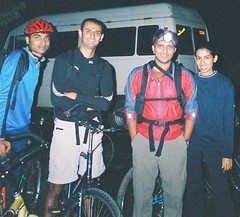
On Saturday night, I signed up to do an all-night bicycle ride. We met up at M.G. Road at 10pm. The organizers piled us into a van and took us to a house south of bangalore, off Kanakpura road, where they had a bunch of cycles. The cycles weren't that great at all - no gears, not the perfect size (too small for me), and a little rickety. They didn't provide helmets either. I was a little disappointed, given that we had paid Rs. 700 for the outing. Anyways, we started with an 8-9 km ride on the highway (it was about 11:45 by the time we started so not too much traffic) after which we took a detour into some small village roads. The roads were super muddy from the heavy rain that we've been having, and generally bumpy because they're inner roads. Needless to say, my backside was in severe pain by the end of the ride. We finished the appx 40km ride at about 5:15am. I had to walk the last 1-2 km of the ride because (a) my butt was sore, (b) the last 9km was uphill, (c) my back tire was pretty flat so it was superhard to ride.
Anyways, I reached home at 7am, took a shower and passed out. At 9:30am I had to pull myself out of bed and spend the entire day (10-5) in the TTF class again.
I ended up getting two movies from vikas - Les triplettes de Belleville (which I'd seen before) and The House of Flying Daggers, which I wanted to see. I finally passed out at 10pm.
It's somehow Tuesday already and I'm down with a terrible cough and cold. I'm guessing it's partly to do with a hectic weekend.
Sindya signed me up for a 3 day class taught by the Teachers Training Foundation in Bangalore - it's an orientation meant for volunteers that are going to take part in the Reading For Real program next year.
Sindya and I have signed up for a few months next year; we'll be storytelling some books to young children who don't have a strong grasp of english, and encouraging them to read.
The training was awesome (though I bunked Friday because of work). I met a bunch of cool people. We learnt about pre/during/post reading activities aimed at holding the children's interest in the story and making sure they grasped it. We got a demo from an amazing storyteller - she had a room full of adults completely mesmerized by her rendition of a story meant for 6 year olds!
On Saturday night, I signed up to do an all-night bicycle ride. We met up at M.G. Road at 10pm. The organizers piled us into a van and took us to a house south of bangalore, off Kanakpura road, where they had a bunch of cycles. The cycles weren't that great at all - no gears, not the perfect size (too small for me), and a little rickety. They didn't provide helmets either. I was a little disappointed, given that we had paid Rs. 700 for the outing. Anyways, we started with an 8-9 km ride on the highway (it was about 11:45 by the time we started so not too much traffic) after which we took a detour into some small village roads. The roads were super muddy from the heavy rain that we've been having, and generally bumpy because they're inner roads. Needless to say, my backside was in severe pain by the end of the ride. We finished the appx 40km ride at about 5:15am. I had to walk the last 1-2 km of the ride because (a) my butt was sore, (b) the last 9km was uphill, (c) my back tire was pretty flat so it was superhard to ride.
Anyways, I reached home at 7am, took a shower and passed out. At 9:30am I had to pull myself out of bed and spend the entire day (10-5) in the TTF class again.
I ended up getting two movies from vikas - Les triplettes de Belleville (which I'd seen before) and The House of Flying Daggers, which I wanted to see. I finally passed out at 10pm.
It's somehow Tuesday already and I'm down with a terrible cough and cold. I'm guessing it's partly to do with a hectic weekend.
Monday, May 23, 2005
Infrastructure
For the second time in a little over a month, our office flooded. Well, not really our whole office. Let me explain.
It doesn't rain that much in Bangalore. It must've rained about 30-40 minutes today. But it rained pretty darn hard. Actually, it even hailed a little. We were standing inside and just joking about how much it would suck if it started to leak (since the roof leaked about a month ago) when someone was like "oh crap! let's go check the server room!"
So we rush over to the rooms where the various pieces of huge electrical equipment are and, sure enough, one of the balconies has overflowed and water has now gone into the main electrical room (where there are electrical wires running on the ground). Some people rushed to start bailing out the room with buckets but then came to their senses. We started bailing the balcony so that no more water would overflow into the electrical room. We couldn't just shut it off because all the servers would have an unclean shutdown. So the sysadmins started doing a server-room shutdown.
In the meantime, another of the balconies was starting to flood, and threatening to flood the office. In addition, the awnings in that balcony were sagging from the weight of water that had collected on them. So we alternated between pushing water off the awnings (to save it from collapsing from its weight) and bailing water out of the balcony (to prevent the office from flooding). Fun times.
It's stopped raining now but I'm guessing it will rain some more tonight. I decided to leave my car in the basement (although I don't really trust that building too much) and take a taxi home in case the roads were bad. A few fallen trees and fender-benders, but nothing major - at least on my route home. I can't imagine what some of the busier streets (Airport Road, Hosur Road) are like. The power is out at home - my building has generator backup (like many apartment complexes here) so I'm still blogging away.
Last time this happened, we had a holiday the next day (actually it ended up being a half day because the servers were brought back up). Wonder if I get to stay in tomorrow.
It doesn't rain that much in Bangalore. It must've rained about 30-40 minutes today. But it rained pretty darn hard. Actually, it even hailed a little. We were standing inside and just joking about how much it would suck if it started to leak (since the roof leaked about a month ago) when someone was like "oh crap! let's go check the server room!"
So we rush over to the rooms where the various pieces of huge electrical equipment are and, sure enough, one of the balconies has overflowed and water has now gone into the main electrical room (where there are electrical wires running on the ground). Some people rushed to start bailing out the room with buckets but then came to their senses. We started bailing the balcony so that no more water would overflow into the electrical room. We couldn't just shut it off because all the servers would have an unclean shutdown. So the sysadmins started doing a server-room shutdown.
In the meantime, another of the balconies was starting to flood, and threatening to flood the office. In addition, the awnings in that balcony were sagging from the weight of water that had collected on them. So we alternated between pushing water off the awnings (to save it from collapsing from its weight) and bailing water out of the balcony (to prevent the office from flooding). Fun times.
It's stopped raining now but I'm guessing it will rain some more tonight. I decided to leave my car in the basement (although I don't really trust that building too much) and take a taxi home in case the roads were bad. A few fallen trees and fender-benders, but nothing major - at least on my route home. I can't imagine what some of the busier streets (Airport Road, Hosur Road) are like. The power is out at home - my building has generator backup (like many apartment complexes here) so I'm still blogging away.
Last time this happened, we had a holiday the next day (actually it ended up being a half day because the servers were brought back up). Wonder if I get to stay in tomorrow.
Sunday, May 22, 2005
Enterprise Software
This is worth a read. Excerpt:
I'm sure that resonates with many. The article is hilarious.
- “Enterprise Software” is a polite way of saying shitty legacy systems and overly complex requirements.
I'm sure that resonates with many. The article is hilarious.
Publishing
A while ago, Neil Gershenfeld gave a talk at amazon about technologies coming down the pipeline. He talked about being able to download blueprints to a home 'printer' and have it 'print out' a working bicycle.
Why is that revolutionary? Well first, there's the obvious cutting of shipment costs. More importantly, by totally changing the cost structure of goods delivery, it removes a lot of traditional Economies of Scale, thus lowering the barrier-to-entry for a new 'producer' (designer might be a better word) in the market. The producer is now free to experiment and customize since the cost of a 'failed' product is only the time lost in the effort.
Thinking about things like that makes one rethink where exactly a company like amazon fits into the market. Though we're not quite there yet (no instantly downloadable bicycles), lulu.com is a company that allows people to upload books in digital format. You can then sell your book (as a physical book, not a download) on sites like amazon. Pretty darn cool, if you ask me. Now that publishers are removed from the equation, the barrier-to-entry for an author is significantly lowered. The up-front costs to them are minimal, and the cost of selling zero copies of your book is just the time you spent writing the book; not the cost of hundreds of unsold printed-and-bound physical books.
Most people aren't ready to read books in digital format (I know I hate reading long articles on my laptop), which has also limited how Long the Tail is for books (the first limiting factor being the barrier-to-entry for authors described above). Lulu has just lengthened the tail for books by changing their cost-structure. Additionally, by allowing self-published books to be sold on amazon, lulu.com is addressing the issue that customers face as they wade through the Long Tail: "how to sort through the junk and find the Good Stuff?" Through its personalization and recommendation features, Amazon has made a name for itself in helping people find and discover items. Lulu is smart to leverage that.
(tip from tpwire)
update a little more reading revealed that amazon hasa acquired booksurge, a similar company.
Why is that revolutionary? Well first, there's the obvious cutting of shipment costs. More importantly, by totally changing the cost structure of goods delivery, it removes a lot of traditional Economies of Scale, thus lowering the barrier-to-entry for a new 'producer' (designer might be a better word) in the market. The producer is now free to experiment and customize since the cost of a 'failed' product is only the time lost in the effort.
Thinking about things like that makes one rethink where exactly a company like amazon fits into the market. Though we're not quite there yet (no instantly downloadable bicycles), lulu.com is a company that allows people to upload books in digital format. You can then sell your book (as a physical book, not a download) on sites like amazon. Pretty darn cool, if you ask me. Now that publishers are removed from the equation, the barrier-to-entry for an author is significantly lowered. The up-front costs to them are minimal, and the cost of selling zero copies of your book is just the time you spent writing the book; not the cost of hundreds of unsold printed-and-bound physical books.
Most people aren't ready to read books in digital format (I know I hate reading long articles on my laptop), which has also limited how Long the Tail is for books (the first limiting factor being the barrier-to-entry for authors described above). Lulu has just lengthened the tail for books by changing their cost-structure. Additionally, by allowing self-published books to be sold on amazon, lulu.com is addressing the issue that customers face as they wade through the Long Tail: "how to sort through the junk and find the Good Stuff?" Through its personalization and recommendation features, Amazon has made a name for itself in helping people find and discover items. Lulu is smart to leverage that.
(tip from tpwire)
update a little more reading revealed that amazon hasa acquired booksurge, a similar company.
Government in business.
India has a socialist legacy. Post independence, we walked the 'middle path' (moderate socialism, or something) for many years. We had privately owned businesses but they were heavily regulated. The government enjoyed monoploy in many core industries.
Today, there are still many examples of government owned businesses; 'state emporiums' (handicrafts, etc. characteristics of each state), aircraft manufacturers, coffee shops... the list is long and varied.
It always surprises visiting Americans to hear of this.
Well I just read that the United States Army makes first-person shooter games. To quote from the article:
Now that is messed up.
Today, there are still many examples of government owned businesses; 'state emporiums' (handicrafts, etc. characteristics of each state), aircraft manufacturers, coffee shops... the list is long and varied.
It always surprises visiting Americans to hear of this.
Well I just read that the United States Army makes first-person shooter games. To quote from the article:
“The technology is what we use for actual training,” says Major Chris Chambers, who directed the E3 presentation for the Army. “We brought it to E3 because it’s also really cool.”
< snip >
But Chambers says he is at the expo for the same reason as the other exhibitors: to showcase the game.
“We intend to be a major player in this industry for a long time,” he says. (emphasis mine)
Now that is messed up.
Tuesday, May 17, 2005
Why gmail?
Maybe this is common knowledge, but it just occurred to me why gmail is such a brilliant idea. Google's pagerank estimates the importance of pages based on links between pages. If I think a page is important, I'll probably link to it. But what if I don't have a website to link from?
When I'm browsing the web, I'm constantly emailing people links that I think they'd find interesting. Sometimes if I'm not feeling lazy, I'll even send some blurb that explains why they should click on the link.
Until recently, Google was completely missing out on this simple and highly reliable way of guaging the importance of pages. Now that google sees my email, they can still apply 'pagerank', but some of the pages in question happen to be emails that people are sending to each other.
Frikkin brilliant. And I thought it was only about the ad revenue.
When I'm browsing the web, I'm constantly emailing people links that I think they'd find interesting. Sometimes if I'm not feeling lazy, I'll even send some blurb that explains why they should click on the link.
Until recently, Google was completely missing out on this simple and highly reliable way of guaging the importance of pages. Now that google sees my email, they can still apply 'pagerank', but some of the pages in question happen to be emails that people are sending to each other.
Frikkin brilliant. And I thought it was only about the ad revenue.
Monday, May 16, 2005
tagging
I love flickr and delicious - both sites that let you organize 'stuff' (photos, links respectively) using tags (arbitrary space separated words that you can assign to things).
Clay Shirky recently posted an excellent essay entitled Ontology is Overrated in which he talks about a bunch of cool stuff and then goes on to say why tags are so damn useful.
But here's an excerpt from early in the document (where he's talking about categorization) that caught my eye:
I'd like to question that asusmption actually... Do you really need a hierarchy to manage a file system? I've spent the last few days going through my OS textbook and doing a bunch of reading/searching about file system design. I think that's an assumption that's ripe to be questioned.
I know that some people have already tried building in 'tag-like' notions into a filesystem. In fact, the defacto filesystem in OSX, HFS+, now (as of Tiger) has support to add arbitrary key/value attributes to files. I haven't downloaded Tiger but, from what I remember from reading reviews, this feature is currently used in only a few places like for ACLs and maybe some Spotlight metadata.
Getting back to the point; why does a file system need heirarchy in order to be manageable? One survey/research paper I read (will post link when I find it again) essentially says "there's too much software out there that assumes that the file sysem is heirarchical so I'm not going to even talk about building something that doesn't have any heirarchy." That may actually be the correct, practical viewpoint to take. But real innovation comes from questioning the 'practical viewpoints' of our day, right?
If a URL is an inode and the title of an html page is a filename, then your filesystem and flickr are not too different. That said, URLs are not as opaque as inodes. If I see a URL with mozilla.org in it, that gives me some clue about the contents even though the exact semantics I associate with it may be varied.
If you know of some work in this area, please enlighten me. In the mean time, I'll be sure to use my not-so-copious amounts of free time to try to read more on the subject.
update: Thanks, Huat, for the pointer. As always, I feel like an idiot for being so clueless about what's out there. :)
update: Interesting; with WinFS, msft is trying to do with the PC, something similar to what the semantic web is trying to do to the internet - give well defined structure and semantics to data. It's hard to get it to work on the web because of how many diverse applications there are, and how loosely structured the data (HTML) fundamentally is. On the PC, though, msft-written software probably makes up a majority of the software you run (not me; I have a mac like any self-respecting yuppie). More importantly, much of the content you create on your PC is created using msft applications. Two questions come up in my mind: (1) how easy is to work with content not created using msft applications; (2) how useful/intuitive is strong typing (vs. tagging) to the end user.
more: I came across this discussion of Longhorn which includes a mini rant at the end about heirarchical file systems.
Clay Shirky recently posted an excellent essay entitled Ontology is Overrated in which he talks about a bunch of cool stuff and then goes on to say why tags are so damn useful.
But here's an excerpt from early in the document (where he's talking about categorization) that caught my eye:
- Ontological classification works well in some places, of course. You need a card catalog if you are managing a physical library. You need a hierarchy to manage a file system. So what you want to know, when thinking about how to organize anything, is whether that kind of classification is a good strategy. (emphasis mine).
I'd like to question that asusmption actually... Do you really need a hierarchy to manage a file system? I've spent the last few days going through my OS textbook and doing a bunch of reading/searching about file system design. I think that's an assumption that's ripe to be questioned.
I know that some people have already tried building in 'tag-like' notions into a filesystem. In fact, the defacto filesystem in OSX, HFS+, now (as of Tiger) has support to add arbitrary key/value attributes to files. I haven't downloaded Tiger but, from what I remember from reading reviews, this feature is currently used in only a few places like for ACLs and maybe some Spotlight metadata.
Getting back to the point; why does a file system need heirarchy in order to be manageable? One survey/research paper I read (will post link when I find it again) essentially says "there's too much software out there that assumes that the file sysem is heirarchical so I'm not going to even talk about building something that doesn't have any heirarchy." That may actually be the correct, practical viewpoint to take. But real innovation comes from questioning the 'practical viewpoints' of our day, right?
If a URL is an inode and the title of an html page is a filename, then your filesystem and flickr are not too different. That said, URLs are not as opaque as inodes. If I see a URL with mozilla.org in it, that gives me some clue about the contents even though the exact semantics I associate with it may be varied.
If you know of some work in this area, please enlighten me. In the mean time, I'll be sure to use my not-so-copious amounts of free time to try to read more on the subject.
update: Thanks, Huat, for the pointer. As always, I feel like an idiot for being so clueless about what's out there. :)
update: Interesting; with WinFS, msft is trying to do with the PC, something similar to what the semantic web is trying to do to the internet - give well defined structure and semantics to data. It's hard to get it to work on the web because of how many diverse applications there are, and how loosely structured the data (HTML) fundamentally is. On the PC, though, msft-written software probably makes up a majority of the software you run (not me; I have a mac like any self-respecting yuppie). More importantly, much of the content you create on your PC is created using msft applications. Two questions come up in my mind: (1) how easy is to work with content not created using msft applications; (2) how useful/intuitive is strong typing (vs. tagging) to the end user.
more: I came across this discussion of Longhorn which includes a mini rant at the end about heirarchical file systems.
Sunday, May 15, 2005
run
The Bangalore Marathon took place today and I ran a 7K 'celebration run'. My time was too pathetic to even mention. My aim was to not stop running but I set my sights too low; I'm totally bummed that I didn't push myself harder. I finished the run with a lot of energy left, which means I probably could've run a lot faster.
Anyways, it was a fun morning; we ran with bright yellow Dream a Dream shirts and then went to Koshy's with some friends. Lunch took an hour and a half to get served and wasn't even that good. Note to self: no more Koshy's. After beer and a big meal though, I'm ready to pass out.
Anyways, it was a fun morning; we ran with bright yellow Dream a Dream shirts and then went to Koshy's with some friends. Lunch took an hour and a half to get served and wasn't even that good. Note to self: no more Koshy's. After beer and a big meal though, I'm ready to pass out.
Thursday, May 12, 2005
pod-frikkin-casting
A friend of mine has been giving me headaches by constantly talking about podcasting and how cool it is. So last night I finally decided to see what the buzz is about and downloaded a podcast client for the mac.
I tried the free 'Lite' version first. The full version has a 30 day trial, but I haven't tried it yet. The Lite version allows you to specify feeds, and download them to a local folder. For any audio files downloaded, you can automatically drop them into iTunes and delete them from the download folder.
This morning, I have two news feeds (one from KOMO news in Seattle and one from Northwest Public Radio), and a jazz feed (don't have the link with me right now) on my iPod.
It was pretty cool to listen to random news on the way to work (instead of the Hindi-Pop and talk shows that are usually on the radio here). Will post more experiences shortly.
Given that the aforementioned friend still hasn't actually downloaded a podcast client, maybe I can talk his head off about podcasting instead.
I tried the free 'Lite' version first. The full version has a 30 day trial, but I haven't tried it yet. The Lite version allows you to specify feeds, and download them to a local folder. For any audio files downloaded, you can automatically drop them into iTunes and delete them from the download folder.
This morning, I have two news feeds (one from KOMO news in Seattle and one from Northwest Public Radio), and a jazz feed (don't have the link with me right now) on my iPod.
It was pretty cool to listen to random news on the way to work (instead of the Hindi-Pop and talk shows that are usually on the radio here). Will post more experiences shortly.
Given that the aforementioned friend still hasn't actually downloaded a podcast client, maybe I can talk his head off about podcasting instead.
Monday, May 09, 2005
how not to get pigeonholed, and other good stuff...
... from fastcompany:
from Escape Your Pigeonhole
from Change or Die
The article talks about how large changes are sometimes so much easier than small, incremental changes. Reminds me of the economic reforms India undertook in the early 90s - it only happened because we were only left with three weeks worth of foreign currency reserves. Since the sweeping changes that took place then, the economic reforms have been a lot slower to come.
Beth over at Creating Passionate Users writes about this article as well.
from Escape Your Pigeonhole
- Vargas highlighted the research skills she gained, rather than the law, and landed a market-research job
<snip >
"I typically make a commitment to a project for 18 to 24 months and offer upfront to groom one of my staff to replace me," Olding says.
<snip >
get pigeonholed as a person who leads new ventures
from Change or Die
- "A relatively small percentage of the population consumes the vast majority of the health-care budget for diseases that are very well known and by and large behavioral."
<snip >
Unless you work on it, brain fitness often begins declining at around age 30 for men, a bit later for women. "People mistake being active for continuous learning," Merzenich says. "The machinery is only activated by learning. People think they're leading an interesting life when they haven't learned anything in 20 or 30 years. My suggestion is learn Spanish or the oboe."
<snip >
What happens if you don't work at mental rejuvenation? Merzenich says that people who live to 85 have a 50-50 chance of being senile. While the issue for heart patients is "change or die," the issue for everyone is "change or lose your mind." Mastering the ability to change isn't just a crucial strategy for business. It's a necessity for health. And it's possibly the one thing that's most worth learning.
The article talks about how large changes are sometimes so much easier than small, incremental changes. Reminds me of the economic reforms India undertook in the early 90s - it only happened because we were only left with three weeks worth of foreign currency reserves. Since the sweeping changes that took place then, the economic reforms have been a lot slower to come.
Beth over at Creating Passionate Users writes about this article as well.
humor me
... and answer this quick poll by adding a comment.
Obviously, most of your conversations about personal issues are going to be with people you know. But I'm talking about conversations about generally non-personal things; movies, current affairs, technology, politics, etc.
There are conversations going on in the blogosphere (through posts, comments, and trackbacks) and in communities like slashdot. Call these 'public' conversations. There is definitely a group of people who are actively engaged in those.
I know that many of my non-personal, electronic conversations are with people I know in the real-world. Call these 'private' conversations. Until before the blogosphere hit its tipping point, most conversations were like this - 'private' in nature and enabled by email, IM, or the likes.
(This conversation that I'm engaging you in is technically 'public' though I'm guessing that my readership right now is mostly people I know)
So you tell me: how important are 'public' conversations to you? Do you find yourself still reverting back to private conversations most of the time? Why? For non-personal stuff, why not open up your conversations to anyone who cares to participate?
- Roughly what percentage of the conversations you have on the web are with people you know, vs. with random digerati?
Obviously, most of your conversations about personal issues are going to be with people you know. But I'm talking about conversations about generally non-personal things; movies, current affairs, technology, politics, etc.
There are conversations going on in the blogosphere (through posts, comments, and trackbacks) and in communities like slashdot. Call these 'public' conversations. There is definitely a group of people who are actively engaged in those.
I know that many of my non-personal, electronic conversations are with people I know in the real-world. Call these 'private' conversations. Until before the blogosphere hit its tipping point, most conversations were like this - 'private' in nature and enabled by email, IM, or the likes.
(This conversation that I'm engaging you in is technically 'public' though I'm guessing that my readership right now is mostly people I know)
So you tell me: how important are 'public' conversations to you? Do you find yourself still reverting back to private conversations most of the time? Why? For non-personal stuff, why not open up your conversations to anyone who cares to participate?
Friday, May 06, 2005
remixing
Are you sick of that word yet? (remixing). sorry. I had to join the bandwagon and comment.
I read this article by joel a while ago that talked about the unix vs windows mentality of building software.
In unix, you build small tools that can be combined together very flexibly (but are typically hard for end-users to use). In windows you build apps that solve a particular use case (but cannot typically be resused/remixed). Unix tools were built by programmers, for programmers, while windows applications were written for end-users.
Companies traditionally have focussed on trying to build end-user applications. They want to completely address every user's problems and dumb you down to a particular workflow. And while that's a nice thought, it totally ignores their most important users; the ones that find great new ways of taking the best parts of what's out there and putting it together. Not all your users will be able to do that; but as soon as one of them does, someone (maybe not you; maybe them, maybe someone else) will find a way to make it easy enough for everyone to use.
Business folk often talk about core competency but when it comes to building software products, they forget about leveraging the core competencies of others in addition to their own, and instead try to be everything to everyone.
As technology creeps into people's daily toolkit, vernacular, and lifestyle; more of us are comfortable thinking like programmers; we're comfortable combining tools together to create 'applications' that are customized to our lifestyle. And that's part of what is enabling the new band of internet innovaters to start building small, great tools.
You've probably heard all of this before. Re-reading the above paragraphs, it feels like I'm replaying a monologue that has been played many times before. But the problem is that there's only a small group of people shouting the same things amongst themselves. Companies are still sitting around scheming up new ways of trying to be everything to their users instead of finding a core competency, kicking ass in that area, and leveraging the brilliant work of others.
I read this article by joel a while ago that talked about the unix vs windows mentality of building software.
In unix, you build small tools that can be combined together very flexibly (but are typically hard for end-users to use). In windows you build apps that solve a particular use case (but cannot typically be resused/remixed). Unix tools were built by programmers, for programmers, while windows applications were written for end-users.
Companies traditionally have focussed on trying to build end-user applications. They want to completely address every user's problems and dumb you down to a particular workflow. And while that's a nice thought, it totally ignores their most important users; the ones that find great new ways of taking the best parts of what's out there and putting it together. Not all your users will be able to do that; but as soon as one of them does, someone (maybe not you; maybe them, maybe someone else) will find a way to make it easy enough for everyone to use.
Business folk often talk about core competency but when it comes to building software products, they forget about leveraging the core competencies of others in addition to their own, and instead try to be everything to everyone.
As technology creeps into people's daily toolkit, vernacular, and lifestyle; more of us are comfortable thinking like programmers; we're comfortable combining tools together to create 'applications' that are customized to our lifestyle. And that's part of what is enabling the new band of internet innovaters to start building small, great tools.
You've probably heard all of this before. Re-reading the above paragraphs, it feels like I'm replaying a monologue that has been played many times before. But the problem is that there's only a small group of people shouting the same things amongst themselves. Companies are still sitting around scheming up new ways of trying to be everything to their users instead of finding a core competency, kicking ass in that area, and leveraging the brilliant work of others.
Wednesday, May 04, 2005
fun at work
From an old article about having fun at Pixar:
At Pixar, the mirth can't be half-assed. "The people who work here know when someone is trying to manipulate them," says Stanton. "For example, someone organized a tug-of-war game at one of our company lunches, but I didn't play. I don't like people telling me when it's time to have fun."
That's so true; I've experienced the feeling of 'being told to have fun' several times. So how do you organize stuff for people at work without making them feel like that?
At Pixar, the mirth can't be half-assed. "The people who work here know when someone is trying to manipulate them," says Stanton. "For example, someone organized a tug-of-war game at one of our company lunches, but I didn't play. I don't like people telling me when it's time to have fun."
That's so true; I've experienced the feeling of 'being told to have fun' several times. So how do you organize stuff for people at work without making them feel like that?
Tuesday, May 03, 2005
hardcoreness?
So a funny thing happened to me the other day.
I met two people through a friend. After a few minutes of chit-chat, one of them said "wow. how come your water bottle is so shiny?" The other chimed in: "I was just thinking the same thing."
I looked down to see that they were pointing at my Nalgene.
"Funny you ask; I just had a friend bring me a new one from the US becuase I lost my old one when I went kayaking a few weeks ago", I replied somewhat sheepishly.
I felt that I had to defend the fact that I had an unscratched Nalgene. That I had to say "no I'm not just another yuppie that bought a nalgene to drink water in the office, i take this thing to rugged places!"
I was thinking about it the other day... anyone in their right mind would've seen a shiny water bottle and assumed it was new. No conversation required there. But the question really was a question about my lifestyle.
Maybe these guys go and beat up their new Nalgene water bottles so they can look cool and rugged? I don't know. But it definitely reminded me of being a kid when I would buy new shoes and go run in the dirt a bit so they wouldn't look so damn white. Though must admit that the thought did cross my mind when I recently bought a pair of tennis shoes. But then I decided that it was a stupid idea.
I met two people through a friend. After a few minutes of chit-chat, one of them said "wow. how come your water bottle is so shiny?" The other chimed in: "I was just thinking the same thing."
I looked down to see that they were pointing at my Nalgene.
"Funny you ask; I just had a friend bring me a new one from the US becuase I lost my old one when I went kayaking a few weeks ago", I replied somewhat sheepishly.
I felt that I had to defend the fact that I had an unscratched Nalgene. That I had to say "no I'm not just another yuppie that bought a nalgene to drink water in the office, i take this thing to rugged places!"
I was thinking about it the other day... anyone in their right mind would've seen a shiny water bottle and assumed it was new. No conversation required there. But the question really was a question about my lifestyle.
Maybe these guys go and beat up their new Nalgene water bottles so they can look cool and rugged? I don't know. But it definitely reminded me of being a kid when I would buy new shoes and go run in the dirt a bit so they wouldn't look so damn white. Though must admit that the thought did cross my mind when I recently bought a pair of tennis shoes. But then I decided that it was a stupid idea.
Sunday, May 01, 2005
rails
So I just finished creating a website with rails. As far as websites go, it really doesn't do that much at all. It's a cross between being slightly overkill for its purpose, yet being too simplistic for harnessing the power of rails.
That said, it was interesting to try to create and deploy a website. I tried to do some 'best practices' things like using subversion for my source control (textdrive provides svn as part of the package), creating a local website on my mac and testing there before doing any deployments, etc. Even though I often changed stuff on the live site, I made all the changes locally and checked them into svn right away. :)
I absolutely hate coming home from work and coding. But
I'm glad I did it because I feel a little more confident about being able to get something up and running from scratch. It's kind of lame that I wasn't comfortable with that, given that I work for a dot-com. But I'm so used to using all the tools and frameworks that we've developed internally, that I hadn't really played with what's out there.
Anyway, aside from bugfixes, I'm done with after-work-coding for a while at least.
That said, it was interesting to try to create and deploy a website. I tried to do some 'best practices' things like using subversion for my source control (textdrive provides svn as part of the package), creating a local website on my mac and testing there before doing any deployments, etc. Even though I often changed stuff on the live site, I made all the changes locally and checked them into svn right away. :)
I absolutely hate coming home from work and coding. But
- I committed to creating a site by the end of the month
- Ruby/Rails was fun to work with
I'm glad I did it because I feel a little more confident about being able to get something up and running from scratch. It's kind of lame that I wasn't comfortable with that, given that I work for a dot-com. But I'm so used to using all the tools and frameworks that we've developed internally, that I hadn't really played with what's out there.
Anyway, aside from bugfixes, I'm done with after-work-coding for a while at least.
Friday, April 29, 2005
Feedburner
I signed up with feedburner just now.
If you're still viewing my blog as a web page, go get a news-reader, or use a web based one, and subscribe to this feed.
Those of you using bloglines can just click here to subscribe to the new feed.
If you're still viewing my blog as a web page, go get a news-reader, or use a web based one, and subscribe to this feed.
Those of you using bloglines can just click here to subscribe to the new feed.
From FC
I love reading Fast Company. Here's some good excerpts:
An article on leadership entitled Borrrrring!:
From Climbing Back Up The Mountain:
Think EMS needs someone to write distributed systems code for them?
From Are All Consultants Corrupt?:
From The Call of the Anti-Extreme Job:
From Soul Proprietor:
update: I didn't finish reading all the stuff I wanted to. Here's some more.
From Natural Leader:
An article on leadership entitled Borrrrring!:
- Under legendary acting teacher Jacques Lecoq, founder of École Jacques Lecoq, Gaulier learned a secret: You can achieve any great vision that you have of yourself -- if your work gives you pleasure
< snip >
"So does one need to go to drama school to learn how to do all this?" I ask Gaulier. No, he says: "Life is a school. Experience teaches you many things. But often, we learn the wrong things from our experiences.
"A lot of events make us contract," he continues. "We learn how to play smaller and smaller roles. A woman may come to think that she is stupid because she has made a few bad decisions. Her voice grows quieter, and she becomes less trusting. Her effectiveness diminishes without her knowing why. Others see that she is performing the role of the frightened creature, but she doesn't see that.
From Climbing Back Up The Mountain:
- To attract such knowledgeable employees and keep them happy, EMS offers flexible work plans with sabbatical-like stretches of vacation time. Several years ago, Bradbury took a year off from EMS to go climbing in the Himalayas. Recently, his assistant manager spent a month rock climbing in Thailand. Such liberties aren't just for management-track employees: After a year, any full-timer can cut out for 90 days' unpaid leave. It's just another part of Manzer's plan to get EMS back on the side of the angels.
Think EMS needs someone to write distributed systems code for them?
From Are All Consultants Corrupt?:
- I don't want my tombstone to read, "He did tolerable stuff for tolerable people because they paid him." I'm not that much of a whore. Do I do it occasionally? Sure. I'm no more noble than anyone else. But that's not the issue. The issue is, Is that your life? Why would you want to spend your life doing stuff that you can just tolerate, working for people you don't like? Especially when you realize that you can make more money doing work that engages your passions. The only sensible business rule is, Life is too short to work for idiots.
From The Call of the Anti-Extreme Job:
At JLT, which supplies rugged laptop computers for extreme conditions, Einck leaves by 5:10 p.m. almost every evening -- and he expects his 15 employees to follow.
<snip>
Einck admits his company could sell more computers if his people worked longer. But at what cost? Last year, JLT's revenue rose more than 50%, to almost $10 million. Any more than that, he says, would have exhausted workers and taxed morale. As it is, "being able to have dinner with my kids and put them to bed is huge," says general manager Lisa Ridley, a mother of two. "Does it makes you more loyal? Absolutely."
From Soul Proprietor:
"Have you ever seen the movie with Robert De Niro and Al Pacino called Heat?" he continues. "De Niro is the bad guy, and Pacino is the good guy. And at one point, De Niro says to Pacino something like, 'One of the things that lets me do what I do is, there's nothing in my life that I won't walk out on in a matter of seconds. Nothing. So if you're going to chase me, and if there's something in your life that you're not willing to walk out on in a few seconds, you're going to lose.' That's what it's like to be an entrepreneur."
update: I didn't finish reading all the stuff I wanted to. Here's some more.
From Natural Leader:
But we have a love-hate relationship with success and failure -- that is, we love success and we hate failure. That's more of an adult phenomenon, by the way. When little kids are first starting to walk and to pick up and drop things, they're fine. There's no judgment associated with those things. Everything's an experiment to them. But by the time people get to be adults, they have almost no tolerance for failure. And that is a very, very dangerous context to have if you want to be a lifelong learner, because the only way to learn is through failure. That's another one of those "aha" moments: when you realize that people work in organizations that religiously try to reduce the risk of failure, when the only way to grow is through experimentation, practice, and risk.
Thursday, April 28, 2005
a bit of inspiration
The Man Who Planted Trees is an amazing feel-good essay with a pretty self explanatory title.
On a related note, there have been vigils to prevent the felling of trees in Bangalore. Go here to find out more.
I heard about the vigils this past Saturday at a festival called Bhoomi Jathre which is an all night music festival hosted by Fireflies, an eco-ashram outside Bangalore. I can't seem to find organized info about when they're held though.
The music festival, by the way, was a lot of fun. I wasn't sure what to expect; the description made me think of Anjuna Beach in Goa, but then I figured there probablyn't wouldn't be too much chemical consumption while listening to indian classical music at an eco-ashram. It was a nice mix of both. Some great organic food stalls, indian classical music, jazz, traditional/fusion dance, art exhibitions. I wanted to scan tickets to keep as a momento, but I left them in my short pockets and they got obliterated in the washing machine.
On a related note, there have been vigils to prevent the felling of trees in Bangalore. Go here to find out more.
I heard about the vigils this past Saturday at a festival called Bhoomi Jathre which is an all night music festival hosted by Fireflies, an eco-ashram outside Bangalore. I can't seem to find organized info about when they're held though.
The music festival, by the way, was a lot of fun. I wasn't sure what to expect; the description made me think of Anjuna Beach in Goa, but then I figured there probablyn't wouldn't be too much chemical consumption while listening to indian classical music at an eco-ashram. It was a nice mix of both. Some great organic food stalls, indian classical music, jazz, traditional/fusion dance, art exhibitions. I wanted to scan tickets to keep as a momento, but I left them in my short pockets and they got obliterated in the washing machine.
Tuesday, April 26, 2005
Breathalizer
So yesterday evening I decided to take Sindya out for a nice dinner; we went to this restaurant called 'Jolly Nawab' at the Windsor Manner hotel. Dinner was great; I had lamb chops marinated in pomengranate juice - extrmeley tender and tasty.
On the way back to Jaynagar (actually, on RV road right around 25th - 30th cross) at about 11:40pm, there were a couple of cops standing around asking people to slow down. One cop asked me if I'd had anything to drink. Since I'd had only a single beer with dinner, I felt I had nothing to hide and answered truthfully. He asked me to pull over and take a breathalizer.
At this point, I was actually feeling really good about the whole thing; there are too many people driving drunk on Bangalore streets and I'm glad that they stop people and check for alcohol.
So anyways, I blow into the instrument once, and the percentage show up as zero; so they ask me to blow again. It still doesn't show up so they ask me how much I had. I tell them that I've only had one beer two or three hours ago when we started dinner (long dinner). Then they ask to me blow once more. At this point, I'm getting a little irritated but oblige anyway.
Finally (since nothing showed up again), the cop is like:
"Okay. three hundred rupee fine!" I was shocked.
"But there's no percentage!"
"If there is a percentage, the fine is a thousand rupees!"
"No. I'm not paying. I've only had one beer, and I'm below the allowed percentage!"
At which point I just turned around and walked back towards the car and drove off. I really wish I knew Kannada so I could yell at the guy. I forgot to get his name so on the way back I actually slowed down, asked him his name ("Kale Gowda", supposedly), thanked him, and drove off.
Oh well, India will be India. I wouldn't really call it extortion, because when I told him I wasn't going to pay, he just kind of let it go. But what is it that incents people like him to ask for bribes? Part one is that they're probably not paid a lot. But neither are cops most places in the world.
A few months ago I heard someone from egovernments.org speak about how they'd been able to significantly increase the income tax collection by making processes transparent, and incenting tax officials to not take bribes and collect fair tax from everyone. Having worked firsthand with income tax officials (known to be the most corrupt of the government departments) from all over the state, he still believed that all of these guys were basically good people who were in a system that incented them towards corrupt practices. That was heartening because I thought I was being completely naiive in the "everyone is basically good" view. Yet here was someone who had worked with hundreds of people first hand and seen them change as a result of a better system.
So part of it is the financial incentives. But I think more than that is the respect. If everyone thinks you're corrupt, you're not going to tarnish your image by taking one more bribe since it's expected of you. I think Bangalore desperately needs someone who can take the police force and turn it around. A great leader, a great PR person, and a great CEO. Any takers?
On the way back to Jaynagar (actually, on RV road right around 25th - 30th cross) at about 11:40pm, there were a couple of cops standing around asking people to slow down. One cop asked me if I'd had anything to drink. Since I'd had only a single beer with dinner, I felt I had nothing to hide and answered truthfully. He asked me to pull over and take a breathalizer.
At this point, I was actually feeling really good about the whole thing; there are too many people driving drunk on Bangalore streets and I'm glad that they stop people and check for alcohol.
So anyways, I blow into the instrument once, and the percentage show up as zero; so they ask me to blow again. It still doesn't show up so they ask me how much I had. I tell them that I've only had one beer two or three hours ago when we started dinner (long dinner). Then they ask to me blow once more. At this point, I'm getting a little irritated but oblige anyway.
Finally (since nothing showed up again), the cop is like:
"Okay. three hundred rupee fine!" I was shocked.
"But there's no percentage!"
"If there is a percentage, the fine is a thousand rupees!"
"No. I'm not paying. I've only had one beer, and I'm below the allowed percentage!"
At which point I just turned around and walked back towards the car and drove off. I really wish I knew Kannada so I could yell at the guy. I forgot to get his name so on the way back I actually slowed down, asked him his name ("Kale Gowda", supposedly), thanked him, and drove off.
Oh well, India will be India. I wouldn't really call it extortion, because when I told him I wasn't going to pay, he just kind of let it go. But what is it that incents people like him to ask for bribes? Part one is that they're probably not paid a lot. But neither are cops most places in the world.
A few months ago I heard someone from egovernments.org speak about how they'd been able to significantly increase the income tax collection by making processes transparent, and incenting tax officials to not take bribes and collect fair tax from everyone. Having worked firsthand with income tax officials (known to be the most corrupt of the government departments) from all over the state, he still believed that all of these guys were basically good people who were in a system that incented them towards corrupt practices. That was heartening because I thought I was being completely naiive in the "everyone is basically good" view. Yet here was someone who had worked with hundreds of people first hand and seen them change as a result of a better system.
So part of it is the financial incentives. But I think more than that is the respect. If everyone thinks you're corrupt, you're not going to tarnish your image by taking one more bribe since it's expected of you. I think Bangalore desperately needs someone who can take the police force and turn it around. A great leader, a great PR person, and a great CEO. Any takers?
Friday, April 15, 2005
My own concierge.
Guido writes about a concierge service. It reminded me that I had wanted to post about this for a while.
Our office folks are pretty cool about constantly doing little stuff to keep people happy at work. Since fruits are extremely cheap in India, they've started stocking the fridge with grapes and watermellons. Every evening at around 3pm they cut the watermellons and everyone in the office slowly congregates around the fridge area to slurp on red, juicy watermellons. that's usually also when you grab a paper cup and scoop out a cup full of grapes to take back to your desk. In the late morning (around 11am-ish), someone comes around with cups of chaas (buttermilk). Oh, and we have a caterer serve a full buffet lunch on the terrace every afternoon.
Everyone who visits from the US is surprised by all this because we're a pretty frugal company in general. But then you consider that our lunch costs the company about $0.70 per day per person (where each person, including me, is costing the company a fraction of what they would in the US) and then it doesn't sound so bad afterall.
Coming back to the original subject of this post; the office signed up with a similar concierge service to the one Guido mentioned, called Les Concierges. They actually send one person to come sit at our office every day for 2 hours. If anyone has any odd jobs they need done they go talk to the person, give them a small advance, and get a receipt. A few days later they'll come back with what you need. My watch died the other day, and the rechargeable battery for my camera has stopped recharging. So I gave them both and asked them to look into things. A few days later they came back to say that they went to the Timex showroom and tried replacing the battery but that the watch still didn't work. Additionally, they went to a couple of Panasonic showrooms to look for rechargeable batteries but couldn't find them.
I would never had had time to leave work, battle the Bangalore traffic, and get this stuff done. They take care of getting all sorts of official government documents (involves standing in long lines), booking tickets for trains/planes/etc., and a bunch of other cool things. They have some funny ones but I don't have the booklet with me.
Our office folks are pretty cool about constantly doing little stuff to keep people happy at work. Since fruits are extremely cheap in India, they've started stocking the fridge with grapes and watermellons. Every evening at around 3pm they cut the watermellons and everyone in the office slowly congregates around the fridge area to slurp on red, juicy watermellons. that's usually also when you grab a paper cup and scoop out a cup full of grapes to take back to your desk. In the late morning (around 11am-ish), someone comes around with cups of chaas (buttermilk). Oh, and we have a caterer serve a full buffet lunch on the terrace every afternoon.
Everyone who visits from the US is surprised by all this because we're a pretty frugal company in general. But then you consider that our lunch costs the company about $0.70 per day per person (where each person, including me, is costing the company a fraction of what they would in the US) and then it doesn't sound so bad afterall.
Coming back to the original subject of this post; the office signed up with a similar concierge service to the one Guido mentioned, called Les Concierges. They actually send one person to come sit at our office every day for 2 hours. If anyone has any odd jobs they need done they go talk to the person, give them a small advance, and get a receipt. A few days later they'll come back with what you need. My watch died the other day, and the rechargeable battery for my camera has stopped recharging. So I gave them both and asked them to look into things. A few days later they came back to say that they went to the Timex showroom and tried replacing the battery but that the watch still didn't work. Additionally, they went to a couple of Panasonic showrooms to look for rechargeable batteries but couldn't find them.
I would never had had time to leave work, battle the Bangalore traffic, and get this stuff done. They take care of getting all sorts of official government documents (involves standing in long lines), booking tickets for trains/planes/etc., and a bunch of other cool things. They have some funny ones but I don't have the booklet with me.
Wednesday, April 13, 2005
innovation
I hadn't seen this kick-ass feature on flickr that lets you add a note to your photograph which shows up when you mouse-over it. Here's an example of it in action. How cool is that?
I love all the rich UI's that people are building.
By the way, with all the talk about ajax, one really cool feature would be an auto-save for any large text boxes (like when I'm blogging or emailing). That way if I lose connectivity, accedentally close my browser window, or anything else, I don't have to worry about losing my data. Does anyone already do this?
I love all the rich UI's that people are building.
By the way, with all the talk about ajax, one really cool feature would be an auto-save for any large text boxes (like when I'm blogging or emailing). That way if I lose connectivity, accedentally close my browser window, or anything else, I don't have to worry about losing my data. Does anyone already do this?
more gmail
I got this email from a buddy:
That's a great question. I hadn't even thought about that. I kind of just assumed that it was a marketting gimmick implying that they are adding capacity. I thought maybe they're doing it at a predictable enough rate that they can just put a counter there for advertising. kind of how McDonald's has the 'number of burgers served' counter.
'Compression' would be an obvious but incomplete answer. Compression of historical data is actually tricky. You face this speed/space tradeoff when you compress, but just saying that you'll compress 'old' data doesn't work because data often goes through cycles of being relevant (think of your bank statements where, at tax time, you may need to go back one year in time). Maybe they've figured out better ways of predicting what data you're interested in, so that they can afford to compress some data a lot, some data a little, some data not at all.
Mail is also a huge revenue generator for them and for people placing ads. Maybe they're good enough at managing their system that the incremental cost of adding storage is less than the predicted incremental ad revenue they're getting (but that answer still boils down to 'more servers').
What else? If you owned all of the email servers in the entire world, maybe you could afford to store a single copy of every email message and just show it to all the people who are meant to receive that email. I doubt Google has reached that critical mass yet. But maybe they do this
with large attachments (since I figure you're only going to send a 300mb file to someone with a gmail account). That means they're actually storing less data. Actually, come to think of it, I think this is quite likely since the google file system would probably make it very very easy to do that.
None of the answers I have address the question of whether that counter means something more than a general prediction of their overall capacity growth (e.g. 200 GB worth of disk per day) combined with the average account usage (e.g. if they have 1tb of capacity and 100 users, they could actually advertise an account limit of more than 10GB if the average usage is much less - just as long as they're constantly forecasting their demand. Also known as overprovisioning.).
What do you think? What is the significance (if any) of the counter?
Thanks, Sood, for a great question to start my day.
- on the gmail login page they now have a continuously increasing, running counter of the max storage space allocated to each account. I've seen running counts like this for "interest paid" on savings account by a given bank which is straight forward since the number simply grows as a function of the interest rate.
What could google be doing that allows the storage space to continue growing a small, but constant rate? When they recently increased from 1gb to 2gb i saw some vaguely worded press release that basically said "we have better technology/methods" for storing information rather than "we bought a bunch more servers"
That's a great question. I hadn't even thought about that. I kind of just assumed that it was a marketting gimmick implying that they are adding capacity. I thought maybe they're doing it at a predictable enough rate that they can just put a counter there for advertising. kind of how McDonald's has the 'number of burgers served' counter.
'Compression' would be an obvious but incomplete answer. Compression of historical data is actually tricky. You face this speed/space tradeoff when you compress, but just saying that you'll compress 'old' data doesn't work because data often goes through cycles of being relevant (think of your bank statements where, at tax time, you may need to go back one year in time). Maybe they've figured out better ways of predicting what data you're interested in, so that they can afford to compress some data a lot, some data a little, some data not at all.
Mail is also a huge revenue generator for them and for people placing ads. Maybe they're good enough at managing their system that the incremental cost of adding storage is less than the predicted incremental ad revenue they're getting (but that answer still boils down to 'more servers').
What else? If you owned all of the email servers in the entire world, maybe you could afford to store a single copy of every email message and just show it to all the people who are meant to receive that email. I doubt Google has reached that critical mass yet. But maybe they do this
with large attachments (since I figure you're only going to send a 300mb file to someone with a gmail account). That means they're actually storing less data. Actually, come to think of it, I think this is quite likely since the google file system would probably make it very very easy to do that.
- What could google be doing that allows the storage space to continue growing a small, but constant rate?
None of the answers I have address the question of whether that counter means something more than a general prediction of their overall capacity growth (e.g. 200 GB worth of disk per day) combined with the average account usage (e.g. if they have 1tb of capacity and 100 users, they could actually advertise an account limit of more than 10GB if the average usage is much less - just as long as they're constantly forecasting their demand. Also known as overprovisioning.).
What do you think? What is the significance (if any) of the counter?
Thanks, Sood, for a great question to start my day.
making people's lives better
FC has an article about Progressive Insurance; their feed had a quote that caught my eye:
Because I work on figuring out how to measure and improve large distributed systems. But the line that I really like from the article is
They're not selling just another product or service; they're selling a way to make people's lives better. And they're thinking about their business that way. Customer focus doesn't just mean making your product easier to use. It means thinking about how your product makes your customer's lives better. I think that's the only reason they were able to think of the kinds of changes described in the article.
Creating Passionate Users is a great place to read more about this.
- "If you want to improve something, start measuring it"
Because I work on figuring out how to measure and improve large distributed systems. But the line that I really like from the article is
- "We're not in the business of auto insurance. We're in the business of reducing the human trauma and economic costs of automobile accidents -- in effective and profitable ways."
They're not selling just another product or service; they're selling a way to make people's lives better. And they're thinking about their business that way. Customer focus doesn't just mean making your product easier to use. It means thinking about how your product makes your customer's lives better. I think that's the only reason they were able to think of the kinds of changes described in the article.
Creating Passionate Users is a great place to read more about this.
Friday, April 08, 2005
rails
I've been hearing a lot lately about the power of the Ruby on Rails framework. I decided that I'm going to create a website and learn ruby and rails in the process.
I've decided to host with textdrive because they support rails. I found textdrive by browsing around some tags on de.icio.us and trying to find the most popular links. Not terribly scientific; I'll let you know my experience with textdrive soon.
First off, there are a bunch of good tutorials on how to get started with rails; even some that specifically address setup on a mac.
My main reason for blogging the experience was that I had problems with the setup. So here's some tips:
I also couldn't remember how to get apache up and running. O'Reilly has a good series on web serving from a mac.
So far so good. I got through most of the rails tutorial and have a lame site running on my mac. I figured I take a detour though and read up a little bit on ruby.
I've decided to host with textdrive because they support rails. I found textdrive by browsing around some tags on de.icio.us and trying to find the most popular links. Not terribly scientific; I'll let you know my experience with textdrive soon.
First off, there are a bunch of good tutorials on how to get started with rails; even some that specifically address setup on a mac.
My main reason for blogging the experience was that I had problems with the setup. So here's some tips:
- After you've installed ruby, it may not be enough to set your path so that your new version (1.8.x) of ruby is found by default. Instead,
mv /usr/bin/ruby
out of the way, andln -s /usr/local/bin/ruby /usr/bin/ruby
- When installing gem,
sudo ruby setup.rb all
- make sure you add theallparameter. Some of the docs don't include it and then you get complaints from the setup util.
I also couldn't remember how to get apache up and running. O'Reilly has a good series on web serving from a mac.
So far so good. I got through most of the rails tutorial and have a lame site running on my mac. I figured I take a detour though and read up a little bit on ruby.
Thursday, April 07, 2005
random
Here's an amazing quote from an FC blog post. Peter Diamandis, the chairman of the X prize foundation answers "why prizes?" :
A prize is typically not intended for incumbent players.
They know it can't be done.
Also; I hadn't heard of this soft drink called "Jones soda" but it seems to be big in Canada. After reading this interview with the founder, I really want to know more.
A cool article about for-profit and not-for-profit organizations collaborating on a project; in this case to produce a better mosquito bed-net.
Instead of doing my daily blog reading, what I really should be doing is figuring out how I'm going to file my US tax returns from India. I'm hoping that I'll just be able to do it all online. I hate taxes. If I ever become an international man of mystery I'm going to make sure that my deal includes someone being personally responsible for filing all of my taxes.
update I hadn't heard of doors of perception but the little bit that I read about it in the past 5 minutes sounds intriguing. They just had a conference in Delhi last week. I have to know more.
They know it can't be done.
Also; I hadn't heard of this soft drink called "Jones soda" but it seems to be big in Canada. After reading this interview with the founder, I really want to know more.
A cool article about for-profit and not-for-profit organizations collaborating on a project; in this case to produce a better mosquito bed-net.
Instead of doing my daily blog reading, what I really should be doing is figuring out how I'm going to file my US tax returns from India. I'm hoping that I'll just be able to do it all online. I hate taxes. If I ever become an international man of mystery I'm going to make sure that my deal includes someone being personally responsible for filing all of my taxes.
update I hadn't heard of doors of perception but the little bit that I read about it in the past 5 minutes sounds intriguing. They just had a conference in Delhi last week. I have to know more.
distributed systems
The work I do is focused on distributed systems. More specifically, on keeping very large, extremely complex distributed systems healthy. This includes collecting metrics, knowing what values of each metric implies a (potential) problem, and figuring out how to respond. In part, one tries to eliminate as many outages as possible. Once you've done your bit there, you try to reduce the time to recovery as much as possible both by building systems that can heal, and by giving humans as much useful information as possible so that when they get woken up at 2am, they waste as little time as possible. And you have to do all of this while not actually screwing up the system that you're trying to manage.
I'm pretty passionate about this area; even though I often complain about being burnt out at work.
I used to maintain a blog on the company intranet pointing to the papers I was reading, as well as some thoughts about how those ideas may affect our work. We solve some pretty huge problems and run an extremely complex distributed system; the blog was internal because I found it difficult to write something meaningful without mentioning internal projects/tools/concepts/ideas.
I recently read one person's attempt at drafting some guidelines on corporate blogging and now I'm tempted to spin off a blog devoted only to distributed systems; obviously with content fit for public consumption.
I'm still mulling over the idea; I'm not sure how meaningful my content can be while not revealing company jewels. Especially since I'm not some famous industry guru or academic.
I'm pretty passionate about this area; even though I often complain about being burnt out at work.
I used to maintain a blog on the company intranet pointing to the papers I was reading, as well as some thoughts about how those ideas may affect our work. We solve some pretty huge problems and run an extremely complex distributed system; the blog was internal because I found it difficult to write something meaningful without mentioning internal projects/tools/concepts/ideas.
I recently read one person's attempt at drafting some guidelines on corporate blogging and now I'm tempted to spin off a blog devoted only to distributed systems; obviously with content fit for public consumption.
I'm still mulling over the idea; I'm not sure how meaningful my content can be while not revealing company jewels. Especially since I'm not some famous industry guru or academic.
Wednesday, April 06, 2005
Kayaking and prawn-stuffed-papad
At 7:25pm last Friday I was still typing away like crazy; trying to commit some last minute code changes.
7:30pm: eat curd rice
8:20pm: on the bus to Dandeli. I was literally jumping with excitement.
We got to Dandeli on Saturday morning. The Karnataka state government run Jungle Lodges and Resorts is an amazing chain - doesn't seem at all like a public sector undertaking. At around 11 am we were off to the river for kayaking lessons. The first drill was to get in the kayak, flip yourself over, and pull out of the kayak. The next drill was to do the same thing with a 'skirt' on. A skirt looks like a skirt, but the bottom of it water-seals the opening to the kayak so that water doesn't go in when you flip upside down. It also means that you have to pull the skirt off when you're upside down and underwater before you can get out of the kayak. A little scary at first.
Krishna, Vikas, Anand, and I did about 2 hours of paddling, capsizing, and attempting rolling, and then took off for lunch. After an amazing Rs. 17 lunch at a local joint, we decided to split up; Anand and Krishna headed back to do a safari and drink some beer; Vikas and I went back for another kayaking session.
Our guide, Kumar, took us paddling down the river to check out the rapids from afar and I was *sooo* pissed that I didn't know how to roll (capsize and then bring myself upright again) my kayak because doing the rapid looked really tempting. He said that I was paddling well enough that if I wanted to try it ("you just have to be able to paddle straight and hard, and have a strong heart. You're paddling okay, but...") - of COURSE I had to try it! I paddled like crazy and made it through the rapid without capsizing. Then, like an idiot, I turned to give him a hi-five with my paddle. At which point I capsized. Since we were out of the rapids, it wasn't a big deal.
Going through the rapid pretty much made the entire trip complete. We tried for another 20-30 minutes to learn the rolls and I never got the hang of it. But I had been longing kayak through white water for a long time so I came away satisfied. I'll be back to the Kali river soon for a few days of lessons.
Sunday morning was spent rafting. Although the rapids were quite tame in a raft, we had a bunch of fun. Our guide kept throwing us out of the raft, and we eventually started picking on people in other rafts as well. I went on a safari in the evening and didn't see a single thing. Oh. we did see a rooster and the eyes of some deer gleaming in our safari-guide's searchlight. I do highly recommend a Jungle Lodges vacation though - they really take care of you.
Monday morning we took a 6am, 4 hour taxi-ride from the hotel to Goa. After unloading at CSM on Baga, we went straight to the beach and ordered some beer and prawn-stuffed-papad. I was a little worried that the papad wouldn't taste as good as I remembered it but I was wrong. It was phenomenal. Twenty drinks, five prawn-stuffed-papads, three prawn-curry-rices, one goan spiced sausage, one pork vindaloo, six hippie-beads, three henna tatoos, three massages, three beach-chairs, and seven hours later, we were down approximately Rs. 1700. I love Goa.
We didn't party that night; though I woke up and 2am and walked into town to check out the action and found it all at 2-3 bars in Baga. Somehow, chilling, eating, drinking, sleeping are more than enough fun for me. On Tuesday morning, Krishna and I rented a scooter and drove around some of the quieter beaches north of Goa. They were very scenic but none had quite the variety of food that Baga did. We came back and hit the beach again and proceeded to gorge ourselves again.
At 7:30pm we finally said goodbye to Baga and caught a bus back home. They have this concept of an 'A/C sleeper Volvo luxury bus' which sounds amazing. The sleeper part is wierd. Instead of having rows of four seats with an aisle in the middle, you have double-decker beds such that you get about 8 people sleeping in the space where you could have seated 12 (each bed is about 3 rows long; you still have 2 beds, then an aisle, and then another two beds, and you have two levels of those). It's pretty damn wierd if you have to sleep next to someone because there's just about 48 inches of width to each bed. I had to get cushy with Krishna, and Anand got luck and got an entire double bed to himself. Anyways, I was back at work at 10am with a tan, a tattoo, and a bushy beard (I'm not in a hurry to get rid of any of them).
I'm definitely going back to Dandeli for a weekend of pure kayaking.
Update:Here're some pictures I uploaded - from Krishna's camera.
7:30pm: eat curd rice
8:20pm: on the bus to Dandeli. I was literally jumping with excitement.
We got to Dandeli on Saturday morning. The Karnataka state government run Jungle Lodges and Resorts is an amazing chain - doesn't seem at all like a public sector undertaking. At around 11 am we were off to the river for kayaking lessons. The first drill was to get in the kayak, flip yourself over, and pull out of the kayak. The next drill was to do the same thing with a 'skirt' on. A skirt looks like a skirt, but the bottom of it water-seals the opening to the kayak so that water doesn't go in when you flip upside down. It also means that you have to pull the skirt off when you're upside down and underwater before you can get out of the kayak. A little scary at first.
Krishna, Vikas, Anand, and I did about 2 hours of paddling, capsizing, and attempting rolling, and then took off for lunch. After an amazing Rs. 17 lunch at a local joint, we decided to split up; Anand and Krishna headed back to do a safari and drink some beer; Vikas and I went back for another kayaking session.
Our guide, Kumar, took us paddling down the river to check out the rapids from afar and I was *sooo* pissed that I didn't know how to roll (capsize and then bring myself upright again) my kayak because doing the rapid looked really tempting. He said that I was paddling well enough that if I wanted to try it ("you just have to be able to paddle straight and hard, and have a strong heart. You're paddling okay, but...") - of COURSE I had to try it! I paddled like crazy and made it through the rapid without capsizing. Then, like an idiot, I turned to give him a hi-five with my paddle. At which point I capsized. Since we were out of the rapids, it wasn't a big deal.
Going through the rapid pretty much made the entire trip complete. We tried for another 20-30 minutes to learn the rolls and I never got the hang of it. But I had been longing kayak through white water for a long time so I came away satisfied. I'll be back to the Kali river soon for a few days of lessons.
Sunday morning was spent rafting. Although the rapids were quite tame in a raft, we had a bunch of fun. Our guide kept throwing us out of the raft, and we eventually started picking on people in other rafts as well. I went on a safari in the evening and didn't see a single thing. Oh. we did see a rooster and the eyes of some deer gleaming in our safari-guide's searchlight. I do highly recommend a Jungle Lodges vacation though - they really take care of you.
Monday morning we took a 6am, 4 hour taxi-ride from the hotel to Goa. After unloading at CSM on Baga, we went straight to the beach and ordered some beer and prawn-stuffed-papad. I was a little worried that the papad wouldn't taste as good as I remembered it but I was wrong. It was phenomenal. Twenty drinks, five prawn-stuffed-papads, three prawn-curry-rices, one goan spiced sausage, one pork vindaloo, six hippie-beads, three henna tatoos, three massages, three beach-chairs, and seven hours later, we were down approximately Rs. 1700. I love Goa.
We didn't party that night; though I woke up and 2am and walked into town to check out the action and found it all at 2-3 bars in Baga. Somehow, chilling, eating, drinking, sleeping are more than enough fun for me. On Tuesday morning, Krishna and I rented a scooter and drove around some of the quieter beaches north of Goa. They were very scenic but none had quite the variety of food that Baga did. We came back and hit the beach again and proceeded to gorge ourselves again.
At 7:30pm we finally said goodbye to Baga and caught a bus back home. They have this concept of an 'A/C sleeper Volvo luxury bus' which sounds amazing. The sleeper part is wierd. Instead of having rows of four seats with an aisle in the middle, you have double-decker beds such that you get about 8 people sleeping in the space where you could have seated 12 (each bed is about 3 rows long; you still have 2 beds, then an aisle, and then another two beds, and you have two levels of those). It's pretty damn wierd if you have to sleep next to someone because there's just about 48 inches of width to each bed. I had to get cushy with Krishna, and Anand got luck and got an entire double bed to himself. Anyways, I was back at work at 10am with a tan, a tattoo, and a bushy beard (I'm not in a hurry to get rid of any of them).
I'm definitely going back to Dandeli for a weekend of pure kayaking.
Update:Here're some pictures I uploaded - from Krishna's camera.
Friday, April 01, 2005
niches, microbrands.
Through a long series of clicks (isn't that how it always is?) I got to this dude Thomas Mahon's blog. He's a tailor on Saville Row. Why would you want to get a suit stiched from him? He answers here. How much will it cost you? Try here. Where can you find him? Well, you could fly to London, like many of his customers, or you could wait for him to come to a city near you.
Damn. I have no idea what services I could render to convince people to fly half way around the world to meet me, but I hope I figure out soon.
Damn. I have no idea what services I could render to convince people to fly half way around the world to meet me, but I hope I figure out soon.
Thursday, March 31, 2005
Legalize
15-yr-olds who have used cannabis within the past year:
From The Economist, Pocket World in Figures, 2005 Edition
The top few countries show about a 5-6% difference between males and females, except the US and France which have about a 10% difference.
| Rank | Male, % | Female, % | ||
|---|---|---|---|---|
| Country | % | Country | % | |
| 1 | Canada | 43.3 | Canada | 37.5 |
| 2 | Switzerland | 40.3 | Switzerland | 35.3 |
| 3 | United States | 36.5 | United Kingdom | 31.7 |
| 4 | United Kingdom | 36.3 | Greenland | 31.1 |
| 5 | Greenland | 36.1 | Spain | 30.0 |
| 6 | Spain | 31.6 | United States | 26.2 |
| 7 | France | 31.2 | France | 23.8 |
| 8 | Czech Republic | 30.9 | Czech Republic | 23.2 |
| 9 | Slovenia | 27.3 | Slovenia | 21.4 |
| 10 | Ireland | 25.5 | Belgium | 20.2 |
The top few countries show about a 5-6% difference between males and females, except the US and France which have about a 10% difference.
Wednesday, March 30, 2005
connected.
Oh I forgot to mention...
I finally got connectivity at home!
The dudes from Airtel came yesterday evening and did some wiring in my house. They then came this morning and hooked up the dsl modem, etc. I was really impressed by how professional they were. They had everything up and running within 25 minutes. And they showed up at the time they promised me. Very rare. I was all smiles. The wireless is up and running as well.
BTW. I still can't concentrate on work.
I finally got connectivity at home!
The dudes from Airtel came yesterday evening and did some wiring in my house. They then came this morning and hooked up the dsl modem, etc. I was really impressed by how professional they were. They had everything up and running within 25 minutes. And they showed up at the time they promised me. Very rare. I was all smiles. The wireless is up and running as well.
BTW. I still can't concentrate on work.
Winding up/down.
Damn.
I'm having problems concentrating right now. I'm feeling pretty burnt out from work and really in need of some chill.
SO here's the plan for this weekend (at the risk of jinxing myself by prematurely publishing it):
I'm sooo excited.
I'm having problems concentrating right now. I'm feeling pretty burnt out from work and really in need of some chill.
SO here's the plan for this weekend (at the risk of jinxing myself by prematurely publishing it):
- Friday night: leave by bus from Bangalore
- Saturday morning: arrive on the banks of the Kali river
- Saturday + Sunday: Take kayaking lessons; possibly do some white-water kayaking.
- Monday morning: Hop on a bus. Arrive in Goa.
- Monday afternoon/Tuesday: What? It's already Tuesday evening!? I want more prawn stuffed papad!
- Wednesday morning: shower at the office and get back into the grind.
I'm sooo excited.
Tuesday, March 29, 2005
Pining for the outdoors.
This past week there's been a tournament going on at KSLTA so we haven't been playing tennis. I went and watched a little bit yesterday morning - it was awe inspiring and made me itch to go play (in private so as not to embarass myself).
Not playing tennis all week, combined with the fact that I haven't been camping or hiking since I got here, plus the fact that we're scambling to meet a code complete deadline; that means I'm just dying to go outside and play.
I found out that there are quite a few adventure travel companies in Bangalore so hopefully I'll get outside this weekend.
It's 2:30am and I'm typically not a night person.
Not playing tennis all week, combined with the fact that I haven't been camping or hiking since I got here, plus the fact that we're scambling to meet a code complete deadline; that means I'm just dying to go outside and play.
I found out that there are quite a few adventure travel companies in Bangalore so hopefully I'll get outside this weekend.
It's 2:30am and I'm typically not a night person.
Thursday, March 24, 2005
Holi
Holi is tomorrow.
We celebrated at work today. Someone brought in colors today and my face, hair, and shirt are now a mixture of yellow, pink, blue, green, red, and some other colors. My shirt is also pretty much soaked with water. I had forgotten to wear old clothes today (actually I figured since Holi is tomorrow I didn't need to do that today).
I'll post pictures as soon as I get them. The office looks funny though because everyone is walking around doing work with peacock colored faces.
Update: Here's a post that has pictures.
We celebrated at work today. Someone brought in colors today and my face, hair, and shirt are now a mixture of yellow, pink, blue, green, red, and some other colors. My shirt is also pretty much soaked with water. I had forgotten to wear old clothes today (actually I figured since Holi is tomorrow I didn't need to do that today).
I'll post pictures as soon as I get them. The office looks funny though because everyone is walking around doing work with peacock colored faces.
Update: Here's a post that has pictures.
Are you happy?
are you happy doing what you do?
On a different note, I'm curious to know what rss feeds you're tracking. Here's what I read. Tell me if there're other interesting ones you think I'd like.
Thursday, March 17, 2005
Life expectency
So I was looking through the Life Expectancy rankings and felt suddenly ashamed at not having even heard of the number one country on the list. I'm even more ashamed to be publicly (well, as public as a blog is since I don't think I have much of a readership anymore) admitting it.
So I went and read about Andorra in the CIA's World Factbook and I think Andorra and the Caymans may not be the most legitimate entrants on this list because they probably have a large population of rich, old transplants that have moved there for tax reasons.
On a different note, I had lunch with Matt (Jigna's husband) and his coworker from Avenade Riccardo today; they were here from Seattle, on a weeklong whirlwind tour of India. They'd spent the week eating at super fancy restaurants in 5 star hotel. I'm glad I was the one to take them to a tiny little south-indian place where they ate a Thaali each (and I drank a lassi) for all of Rs. 77.
I was hoping to treat them to the lunch in exchange for a lunch treat in Seattle, but they wouldn't let me. Damn.
Random Tidbit: Check out Experience with Evaluating Human-Assisted Recovery Processes from the ROC group at Berkeley.
| Rank | Country | Years | |
|---|---|---|---|
| 1 | Andorra | 83.5 | |
| 2 | Japan | 81.6 | |
| 3 | Sweden | 80.1 | |
| 4 | Hong Kong | 79.9 | |
| 5 | Iceland | 79.8 | |
| 6 | Cayman Islands | 79.7 | |
| 7 | Canada | 79.3 | |
| 8 | Spain | 79.3 | |
| 9 | Australia | 79.2 | |
| 10 | Israel | 79.2 |
So I went and read about Andorra in the CIA's World Factbook and I think Andorra and the Caymans may not be the most legitimate entrants on this list because they probably have a large population of rich, old transplants that have moved there for tax reasons.
On a different note, I had lunch with Matt (Jigna's husband) and his coworker from Avenade Riccardo today; they were here from Seattle, on a weeklong whirlwind tour of India. They'd spent the week eating at super fancy restaurants in 5 star hotel. I'm glad I was the one to take them to a tiny little south-indian place where they ate a Thaali each (and I drank a lassi) for all of Rs. 77.
I was hoping to treat them to the lunch in exchange for a lunch treat in Seattle, but they wouldn't let me. Damn.
Random Tidbit: Check out Experience with Evaluating Human-Assisted Recovery Processes from the ROC group at Berkeley.
Wednesday, March 16, 2005
Pay what you like
A while ago I read something about an internet content-charging paradigm that is summarized by the phrase "pay what you think it's worth". I go read a blog entry that I think is superb, so I donate the author $1.50 for her wisdom. Then I read some piece-of-crap article and close my browser tab without a second thought.
Seems like a pretty reasonable concept. I think I read somewhere on The Long Tail (though I'm lazy to find the exact post) that a similar model could be used for all sorts of 'independent content' (think indie bands, indie movies, etc).
Here's an article about someone who tried that for a restaurant. Clearly it caused lots of anxiety for both the restauranter as well as the diners. I wonder if it was only because of the human-interaction factor, or if there were other factors involved? i.e. is there a lesson here about online settings in which this strategy wouldn't work?
Incidentally, I think it's funny that some good old desi guys headed over there and ate for free. $5 says they were Guju ;)
Seems like a pretty reasonable concept. I think I read somewhere on The Long Tail (though I'm lazy to find the exact post) that a similar model could be used for all sorts of 'independent content' (think indie bands, indie movies, etc).
Here's an article about someone who tried that for a restaurant. Clearly it caused lots of anxiety for both the restauranter as well as the diners. I wonder if it was only because of the human-interaction factor, or if there were other factors involved? i.e. is there a lesson here about online settings in which this strategy wouldn't work?
Incidentally, I think it's funny that some good old desi guys headed over there and ate for free. $5 says they were Guju ;)
Tuesday, March 15, 2005
Environmental Sustainability
Are you (I'm assuming that someone is reading this thing) bored of country statistics yet?
Here's another one, assuming that you're not. A ranking of countries by environmental sustainability index:
In other news, a9 launched OpenSearch today. It got some great reviews, and some not so great reviews. I guess I agree with Greg's comments; it would have been a nice launch gesture for a9 to expose its own search in OpenSearch format. One thought I had was that I may soon need a meta-search to find the OpenSearch search add-ons that I really want.
I need to find blogs where I can read realtime reviews of O'Reilly's etech.
Here's another one, assuming that you're not. A ranking of countries by environmental sustainability index:
| Country | index |
|---|---|
| Finland | 73.9 |
| Norway | 73.0 |
| Sweden | 72.6 |
| Canada | 70.6 |
| Switzerland | 66.5 |
| Uruguay | 66.0 |
| Austria | 64.2 |
| Iceland | 63.9 |
| Costa Rica | 63.2 |
| Latvia | 63.0 |
In other news, a9 launched OpenSearch today. It got some great reviews, and some not so great reviews. I guess I agree with Greg's comments; it would have been a nice launch gesture for a9 to expose its own search in OpenSearch format. One thought I had was that I may soon need a meta-search to find the OpenSearch search add-ons that I really want.
I need to find blogs where I can read realtime reviews of O'Reilly's etech.
Monday, March 14, 2005
Quality Of Life
This is a rank of countries by the Human Development Index, compiled by the UNDP.
Does anyone else see a correlation between how frikkin cold a country is and its HDI ranking? Why is it that you have to skip all the way down to like 25 before the weather gets consistently warm. Or is Hong Kong 25 because the weather is consistently warm?
If you click around on the UNDP site you should be able to find some descriptions of the index. It looks like it weighs factors like Life Expectancy, Literacy, Gross enrollment in primary/secondary/tertiary schools, and GDP per captita.
What is it about hot places that puts them low on the list? Even Australia gets kinda cold. Why aren't any tropical islands chilling (metaphorically speaking) in the top 10?
| Rank | Country |
|---|---|
| 1 | Norway |
| 2 | Iceland |
| 3 | Sweden |
| 4 | Australia |
| 5 | Netherlands |
| 6 | Belgium Canada United States |
| . | ... |
| 25 | Honk Kong |
| 26 | Barbados |
| 27 | Singapore |
Does anyone else see a correlation between how frikkin cold a country is and its HDI ranking? Why is it that you have to skip all the way down to like 25 before the weather gets consistently warm. Or is Hong Kong 25 because the weather is consistently warm?
If you click around on the UNDP site you should be able to find some descriptions of the index. It looks like it weighs factors like Life Expectancy, Literacy, Gross enrollment in primary/secondary/tertiary schools, and GDP per captita.
What is it about hot places that puts them low on the list? Even Australia gets kinda cold. Why aren't any tropical islands chilling (metaphorically speaking) in the top 10?
Sunday, March 13, 2005
Largest Countries
This weekend I picked up The Economist's Pocket World in Figures 2005. It's a great 2 minute diversion during the work day.
So here are the largest countries (includes freshwater):
So here are the largest countries (includes freshwater):
| Rank | Country | Area, sq km |
|---|---|---|
| 1 | Russia | 17075 |
| 2 | Canada | 9971 |
| 3 | China | 9561 |
| 4 | United States | 9373 |
DVDs
A coworker took me to an area of Bangalore known as Majestic. Most cities in India seem to have an area like this; it's near the main bus and/or railway station, it's super crowded, has lodges (motels) on every corner, lots of cheap eating places, and many shops specializing in gray/black market goods.
We went to these tiny stores which sell DVDs for Rs. 110 ($2) each. Most of them have somewhere between 2 and 5 movies per DVD. I picked up Finding Neverland (loved it), Road to Perdition (haven't seen it yet), and a few others.
Oh. While we were there, another customer came and asked for some 'special english movies'. He was handed a paper packet which he looked into. Then he asked the shopkeeper for his top pick among the three movies that he was apparently handed. After some discussion revolving around verifying the picture quality, he left with a DVD. Good to see that the oldest trade in the world is high tech, pirated, and flourishing.
I definitely have to go back to that area and check out all the other stuff there - imported electronics, fake perfumes, fake watches, fake shoes, etc.
We went to these tiny stores which sell DVDs for Rs. 110 ($2) each. Most of them have somewhere between 2 and 5 movies per DVD. I picked up Finding Neverland (loved it), Road to Perdition (haven't seen it yet), and a few others.
Oh. While we were there, another customer came and asked for some 'special english movies'. He was handed a paper packet which he looked into. Then he asked the shopkeeper for his top pick among the three movies that he was apparently handed. After some discussion revolving around verifying the picture quality, he left with a DVD. Good to see that the oldest trade in the world is high tech, pirated, and flourishing.
I definitely have to go back to that area and check out all the other stuff there - imported electronics, fake perfumes, fake watches, fake shoes, etc.
Saturday, March 12, 2005
sing your heart out.
Yesterday we had a little company-party-thing and They wanted to turn it into a mini talent show so a couple of us brought guitars in and practiced for 10 minutes in the evening before singing on the roof of our office. A bunch of people sang. Birla did an awesome job getting the entire crowd to participate in his singing. Pretty amazing.
So anyways, fast forward three hours. 10pm and I was headed back home from my fiancee's place. It started raining really hard. Having lived in the colder parts of the US for a long time, I really miss warm rain and thunderstorms. I was just dying to get out of the car and run around in the rain. Rather than risk stopping in Bangalore traffic, I changed my route so that I'd go through Cubbon Park.
I found a convinient place to pull over and, wouldn't you know it, the rain had by then slowed to a drizzle. No matter; standing in the rain still felt awesome. Since I had my guitar in the car, I decided to put up the hatchback door and sit in the trunk (to prevent the guitar getting too wet) and strum and sing.
It was raining, somewhat dark (save the few streetlamps), and the only people around were the not-so-frequent caravans of cars taking a shortcut through the park. It was awesome. I just sang at the top of my voice for 30 minutes. I even had one dude stop his van and come listen to me for a few minutes and tell me how much he wanted to learn to play the guitar.
I just read about how potting plants has been the secret to someone's success. I don't have a particular, single hobby that gives me the plant-potting effect - I generally rejeuvinate either by learning to do new stuff or pursuing one of the many proverbial Trades that I am a Jack of - but I completely empathize with the sentiments.
I have never tried taking time off to pursue something different - maybe I'll try plant-potting soon...
So anyways, fast forward three hours. 10pm and I was headed back home from my fiancee's place. It started raining really hard. Having lived in the colder parts of the US for a long time, I really miss warm rain and thunderstorms. I was just dying to get out of the car and run around in the rain. Rather than risk stopping in Bangalore traffic, I changed my route so that I'd go through Cubbon Park.
I found a convinient place to pull over and, wouldn't you know it, the rain had by then slowed to a drizzle. No matter; standing in the rain still felt awesome. Since I had my guitar in the car, I decided to put up the hatchback door and sit in the trunk (to prevent the guitar getting too wet) and strum and sing.
It was raining, somewhat dark (save the few streetlamps), and the only people around were the not-so-frequent caravans of cars taking a shortcut through the park. It was awesome. I just sang at the top of my voice for 30 minutes. I even had one dude stop his van and come listen to me for a few minutes and tell me how much he wanted to learn to play the guitar.
I just read about how potting plants has been the secret to someone's success. I don't have a particular, single hobby that gives me the plant-potting effect - I generally rejeuvinate either by learning to do new stuff or pursuing one of the many proverbial Trades that I am a Jack of - but I completely empathize with the sentiments.
I have never tried taking time off to pursue something different - maybe I'll try plant-potting soon...
Thursday, March 10, 2005
alien rights
I must admit I've been totally out of touch with any sort of news for a while now. Even though I now get the paper every morning - I rarely have time to actually read it.
But I just stumbled across this article that talks about how the US has withdrawn from the international protocol "that guarantees jailed foreigners the right to talk to consular officers". Wow.
But I just stumbled across this article that talks about how the US has withdrawn from the international protocol "that guarantees jailed foreigners the right to talk to consular officers". Wow.
Wednesday, March 09, 2005
Conference, day 2
Day 2 started with... well.... I'm not sure exactly how it started because we had a 'breakfast meeting' (which involved devouring the leela breakfast buffet among other, less important, things).
I got there in time for a talk on Enterprise Middleware by Prof Joshi but it was mostly text-book stuff so my attention span didn't last through the entire presentation.
I got a chance to chat with Prof. Umesh Bellur before his talk on autonomous systems. It was, again, a very cursory introduction to the topic but held my attention because I've been very involved and passionate about the space for the past year or so.
I missed the next few talks (on security) because I was:
The final talk of the day was by Werner. You can read more about that here (although the link is for a Bangalore event, the abstract of the talk is the same).
And that was it. After being bombarded by questions about jobs and what we're working on, we took off for the airport with a slight detour at a roadside bhel-puri-wallah. I frikkin passed out on the plane.
I got there in time for a talk on Enterprise Middleware by Prof Joshi but it was mostly text-book stuff so my attention span didn't last through the entire presentation.
I got a chance to chat with Prof. Umesh Bellur before his talk on autonomous systems. It was, again, a very cursory introduction to the topic but held my attention because I've been very involved and passionate about the space for the past year or so.
I missed the next few talks (on security) because I was:
- taking a nap on the grass under a tree (I haven't done that in ages! IIT has a beautiful campus
- getting a demo of a distributed system simulation tool that Varsha Apte is building with some students
The final talk of the day was by Werner. You can read more about that here (although the link is for a Bangalore event, the abstract of the talk is the same).
And that was it. After being bombarded by questions about jobs and what we're working on, we took off for the airport with a slight detour at a roadside bhel-puri-wallah. I frikkin passed out on the plane.
Conference, day 1
Last weekend I attended Convergence 2005
at IITB, Powai. The topic for the talk was "Computing Infrastructure
in Enterprise Networks". (Click here
for details.)
I took a 7am Jet Airways flight from Bangalore to Mumbai. Jet
Airways has some pretty awesome breakfast. I was looking forward to
eating a huge (complimentary) breakfast buffet at the Leela after
getting there but:
a) We had to dump our bags and take off right away for IIT
b) I was already kind of full from the breakfast on the plane :)
I missed the keynote, but got to hear Prof. Iyer give an overview
of enterprise networks. It was pretty interesting: he started by
looking at a single node and seeing what problems there were at the
application and administration levels. Then he talked about managing a
small cluster of nodes (e.g. a lab at IIT), followed by a cluster of
clusters (a department); etc., all the way up to looking at the public
internet.
Mr Ganguly from Intel spoke next. I don't think the talk was
extremely relevant to the topic of the conference. He basically ran us
through Intel's product line. Maybe I missed the point slightly.
During lunch I got to chat with a few students and find out what
they're working on. The particular student I spoke with was looking at
the problem of data forecasting and how, after removing the
seasonality and trend components of a time series, he believed there
are still more patterns to be derived out of the white-noise component
that's left behind.
After lunch, Prof Om Damani gave an overview to load balancing
solutions. I didn't get a chance to talk with him in detail but he's
worked at Akamai (and TJ Watson) so I'm sure he has some pretty cool
real-world experiences to share.
Mr. Manoj Chugh (President, EMC2 india) gave the next talk regarding
EMC2's storage strategy. It was a well delivered, highly entertaining
talk with a lot of vision but little content. I wish I had his public
speaking skills and presence.
Post-tea-and-samosa-break, Prof Varsha Apte was to
give a talk on Queuing Theory and capacity planning. Following a great
speaker and a tea break; being the last session of the day; and trying
to teach an auditorium full of people the intricacies of Queueing Threory is no easy
task. She did a great job motivating the need to study queueing theory
as well as giving people an intuitive understanding of the
subject. She ended with a discussion of a real-world example from AT&T
labs where she had used some queuing theory to identify bottlenecks in a
server.
Before leaving for Bombay I had found out that Leela Bombay has a squash court. Vikas and I played an amazing and exhausting hour of squash
(I got my ass beat again though) and then cooled off in a pool for a few minutes.
The rest of the evening was spent drinking, eating, and chilling with
Werner. and Drew. I think we actually started dinner at 11:15 or something ridiculous like that so it was past 1 by the time I got to bed. 6:30am squash plans were cancelled though I made a valiant effort (I set my alarm and even got out of bed to switch it off).
at IITB, Powai. The topic for the talk was "Computing Infrastructure
in Enterprise Networks". (Click here
for details.)
I took a 7am Jet Airways flight from Bangalore to Mumbai. Jet
Airways has some pretty awesome breakfast. I was looking forward to
eating a huge (complimentary) breakfast buffet at the Leela after
getting there but:
a) We had to dump our bags and take off right away for IIT
b) I was already kind of full from the breakfast on the plane :)
I missed the keynote, but got to hear Prof. Iyer give an overview
of enterprise networks. It was pretty interesting: he started by
looking at a single node and seeing what problems there were at the
application and administration levels. Then he talked about managing a
small cluster of nodes (e.g. a lab at IIT), followed by a cluster of
clusters (a department); etc., all the way up to looking at the public
internet.
Mr Ganguly from Intel spoke next. I don't think the talk was
extremely relevant to the topic of the conference. He basically ran us
through Intel's product line. Maybe I missed the point slightly.
During lunch I got to chat with a few students and find out what
they're working on. The particular student I spoke with was looking at
the problem of data forecasting and how, after removing the
seasonality and trend components of a time series, he believed there
are still more patterns to be derived out of the white-noise component
that's left behind.
After lunch, Prof Om Damani gave an overview to load balancing
solutions. I didn't get a chance to talk with him in detail but he's
worked at Akamai (and TJ Watson) so I'm sure he has some pretty cool
real-world experiences to share.
Mr. Manoj Chugh (President, EMC2 india) gave the next talk regarding
EMC2's storage strategy. It was a well delivered, highly entertaining
talk with a lot of vision but little content. I wish I had his public
speaking skills and presence.
Post-tea-and-samosa-break, Prof Varsha Apte was to
give a talk on Queuing Theory and capacity planning. Following a great
speaker and a tea break; being the last session of the day; and trying
to teach an auditorium full of people the intricacies of Queueing Threory is no easy
task. She did a great job motivating the need to study queueing theory
as well as giving people an intuitive understanding of the
subject. She ended with a discussion of a real-world example from AT&T
labs where she had used some queuing theory to identify bottlenecks in a
server.
Before leaving for Bombay I had found out that Leela Bombay has a squash court. Vikas and I played an amazing and exhausting hour of squash
(I got my ass beat again though) and then cooled off in a pool for a few minutes.
The rest of the evening was spent drinking, eating, and chilling with
Werner. and Drew. I think we actually started dinner at 11:15 or something ridiculous like that so it was past 1 by the time I got to bed. 6:30am squash plans were cancelled though I made a valiant effort (I set my alarm and even got out of bed to switch it off).
Tuesday, March 08, 2005
iPod
This particular entry is about 5 months late. Before leaving Seattle, some of my buddies chipped in to buy me a yuppie accessory to my yuppie iMac; an iPod. I wasn't completely sure how much I'd use it, even though I really wanted one.
I must say that the iPod kicks butt. I pretty much don't go anywhere without it. As soon as I sit in the car, I hook it up to my car stereo (nothing fancy, just through a microphone-like input jack that my casette deck has). When I get to work, I'm listening to it. When I get home, I hook it up to my home stereo.
I've been going through and rating my songs. I have an 'unrated' list which is reverse sorted by the last time I heard a song (least recently). Whenever I listen to one of those, it either gets:
- 1 star: delete next time I sync with my mac
- 2 star: hate it but keeping it for various reasons (such as: fiancee likes song)
- 3 star: undecided
- 4/5 star: I want to listen to this when I want instant gratification from good music.
So when I'm particularly frustrated with traffic in Bangalore or work, I switch to the top rated list. The rest of the time I go through the process of rating my music.
It has definitely added to my standard of living; another humungous (and somewhat delayed) thank you to all my buddies for the wonderful gift. Now if anyone wants to send me some new music... :)
(BTW - is there a way to share iTunes song ratings and/or find new music based on those ratings?)
I must say that the iPod kicks butt. I pretty much don't go anywhere without it. As soon as I sit in the car, I hook it up to my car stereo (nothing fancy, just through a microphone-like input jack that my casette deck has). When I get to work, I'm listening to it. When I get home, I hook it up to my home stereo.
I've been going through and rating my songs. I have an 'unrated' list which is reverse sorted by the last time I heard a song (least recently). Whenever I listen to one of those, it either gets:
- 1 star: delete next time I sync with my mac
- 2 star: hate it but keeping it for various reasons (such as: fiancee likes song)
- 3 star: undecided
- 4/5 star: I want to listen to this when I want instant gratification from good music.
So when I'm particularly frustrated with traffic in Bangalore or work, I switch to the top rated list. The rest of the time I go through the process of rating my music.
It has definitely added to my standard of living; another humungous (and somewhat delayed) thank you to all my buddies for the wonderful gift. Now if anyone wants to send me some new music... :)
(BTW - is there a way to share iTunes song ratings and/or find new music based on those ratings?)
Wednesday, March 02, 2005
Tennis
I've been terrible about keeping this up-to-date. Why?
1) My parents were in town for a few weeks
2) I got (and am) super busy at work
3) I got a little depressed about b'lore.
#3 is an interesting one. I usually get a little down if I don't exercise in a long time. All it takes is a few days of going running to get my spirits up again. Well, the whole move and everything screwed up my schedule and I didn't realize that I hadn't been doing any exercise. So little things at work and in Bangalore got me depressed.
But we finally signed up for a tennis membership a few weeks ago. Since then we also started taking tennis lessons every morning from 9-10am. So my new schedule looks something like this:
7:00 : out of bed
7:30 : at work
8:45 : leave work
9:00 : tennis coaching
10:00 : gym
10:30 : shower
10:45 : breakfast (idli/sambar, kesri bhath, lassi, coffee all for about Rs. 50)
23:00 : go to bed.
I love it. The weather here is amazing. In the mornings and evenings there's a cool breeze. Around 9-10 when we play tennis, it's pretty hot and I hit the shower just drenched with sweat. I missed that a lot while living in north america.
I'm also glad to be taking tennis lessons 5 days a week though it leaves me pretty exhausted. After a few months we'll probably cut down to taking lessons only a few times a week so we'll have time left over to just play, or go running, or climbing, or something else. The tennis club (KSLTA) is bang in the middle of cubbon park (in the middle of bangalore) so it's convinient to go running or climbing.
More later.
1) My parents were in town for a few weeks
2) I got (and am) super busy at work
3) I got a little depressed about b'lore.
#3 is an interesting one. I usually get a little down if I don't exercise in a long time. All it takes is a few days of going running to get my spirits up again. Well, the whole move and everything screwed up my schedule and I didn't realize that I hadn't been doing any exercise. So little things at work and in Bangalore got me depressed.
But we finally signed up for a tennis membership a few weeks ago. Since then we also started taking tennis lessons every morning from 9-10am. So my new schedule looks something like this:
7:00 : out of bed
7:30 : at work
8:45 : leave work
9:00 : tennis coaching
10:00 : gym
10:30 : shower
10:45 : breakfast (idli/sambar, kesri bhath, lassi, coffee all for about Rs. 50)
23:00 : go to bed.
I love it. The weather here is amazing. In the mornings and evenings there's a cool breeze. Around 9-10 when we play tennis, it's pretty hot and I hit the shower just drenched with sweat. I missed that a lot while living in north america.
I'm also glad to be taking tennis lessons 5 days a week though it leaves me pretty exhausted. After a few months we'll probably cut down to taking lessons only a few times a week so we'll have time left over to just play, or go running, or climbing, or something else. The tennis club (KSLTA) is bang in the middle of cubbon park (in the middle of bangalore) so it's convinient to go running or climbing.
More later.
Subscribe to:
Posts (Atom)